-
The Suppressed Cure: How Public Health Policy May Have Abandoned Millions

By Larry D. Burton
(more…)
Picture a man in his late sixties. He was a carpenter for forty years—strong hands, precise movements, a craftsman’s pride in what those hands could do. Now he sits across from his neurologist and receives a diagnosis that will spend the next decade systematically dismantling everything he was. His hands will shake. His balance will betray him. His face will lose its expressiveness. His voice will fade to a whisper.
Parkinson’s disease has no cure. It has no therapy that stops it. It can be managed, slowed somewhat, made marginally more bearable—but it cannot be defeated.
Now imagine that somewhere in the medical literature, buried under decades of institutional indifference, there exists a signal—consistent, replicated, peer-reviewed—suggesting that a common molecule may protect the very neurons his disease is destroying.
Imagine that signal has been sitting there, largely ignored, since 1959.
That is not a hypothetical. That is where we are. -
The Illusion of Non-Partisanship: Georgia’s HB 369 Problem
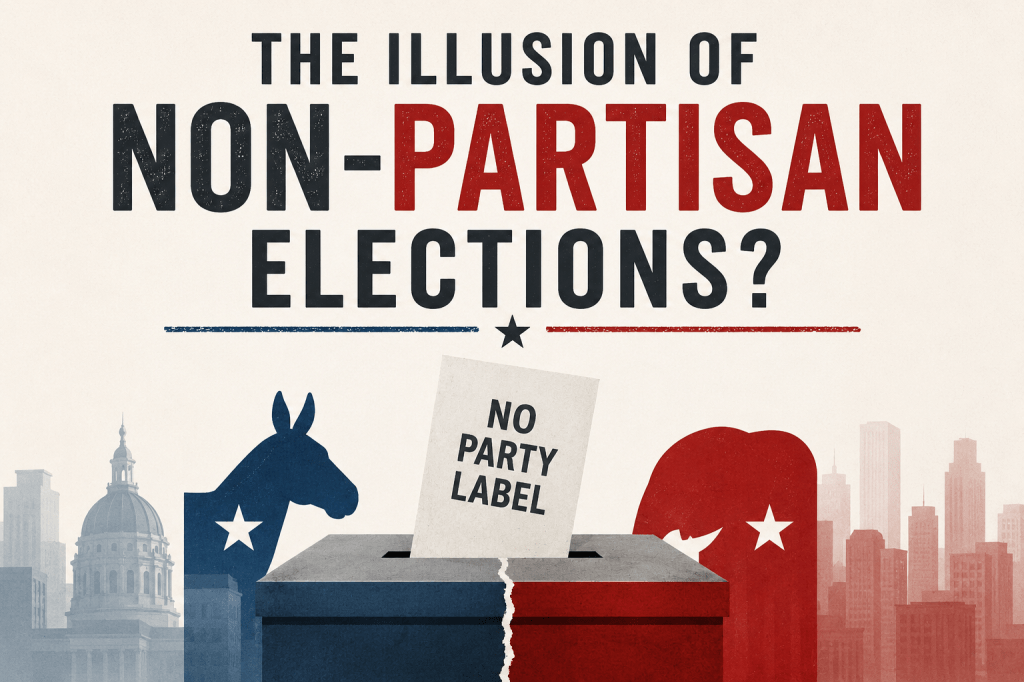
There is an idea buried inside Georgia House Bill 369 that I actually agree with.
In theory, local government should not function like cable news with zoning maps. County commissioners, sheriffs, and district attorneys are supposed to solve practical problems: roads, development, policing, budgets, emergency response. There is a reasonable argument that local offices should become less partisan, not more.
But HB 369 is not a serious attempt to create non-partisan government.
It is a selective, politically engineered half-measure that removes party labels from the ballot while leaving the actual party machinery completely untouched.
And that is the conundrum.
(more…) -
Two Paths Through the Same County: Holtkamp and Chowdhury in District 4
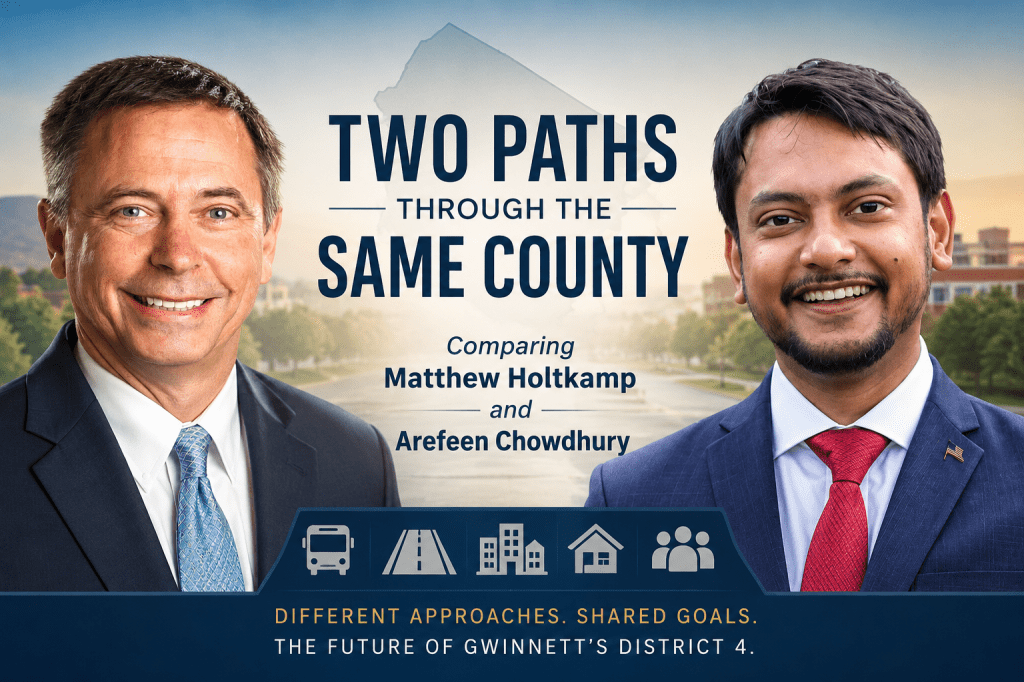
Gwinnett County Commission District 4 may be one of the more interesting local races on the ballot this year — not because the candidates are radically different, but because in many ways they are surprisingly alike.
The more I’ve looked into incumbent Matthew Holtkamp and challenger Arefeen Chowdhury, the less this race looks like a battle between opposites. Instead, it increasingly feels like two men approaching the same problems from different directions and arriving near the same destination.
(more…) -
Arefeen Chowdhury: The Systems Thinker Challenging Gwinnett’s Status Quo
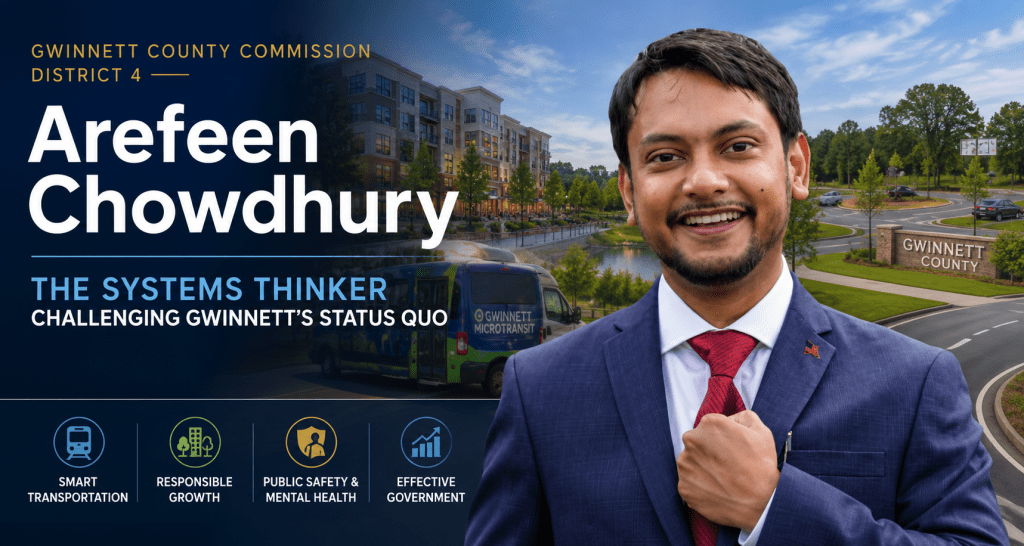
Gwinnett County Commission District 4 challenger Arefeen Chowdhury does not come across as a traditional politician.
After spending time speaking with him at length, the impression left is less “campaign speech” and more “operations manager.” Chowdhury talks about county government the same way a corporate executive talks about logistics, efficiency, staffing, customer service, and long-term planning.
Whether voters ultimately agree with him or not, one thing becomes clear quickly: he has spent serious time thinking about where Gwinnett is headed.
And just as importantly, where he believes it could go wrong.
(more…) -
Matthew Holtkamp and the Shape of Gwinnett’s Future
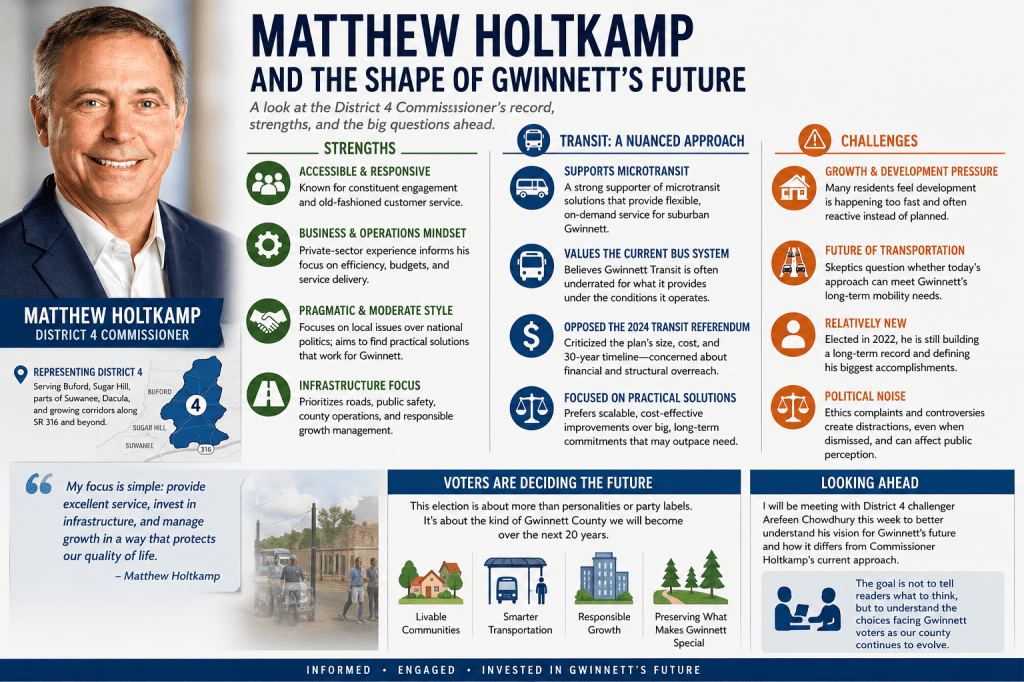
Gwinnett County Commissioner District 4 incumbent Matthew Holtkamp occupies an interesting political position in modern Gwinnett County politics. He is neither a bomb-throwing culture warrior nor a progressive urban planner. Instead, Holtkamp presents himself as a practical suburban commissioner focused on operations, infrastructure, public services, and controlled growth.
After spending time speaking with him directly, reviewing his public positions, and observing reactions from residents across District 4, one thing becomes clear: Holtkamp’s political identity is rooted more in management and responsiveness than ideology.
That approach may fit Gwinnett County at a time when many residents are exhausted by national politics but deeply concerned about growth, congestion, development, taxes, and quality of life.
(more…) -
Gwinnett Commission District 4: A Race About More Than Just One Seat
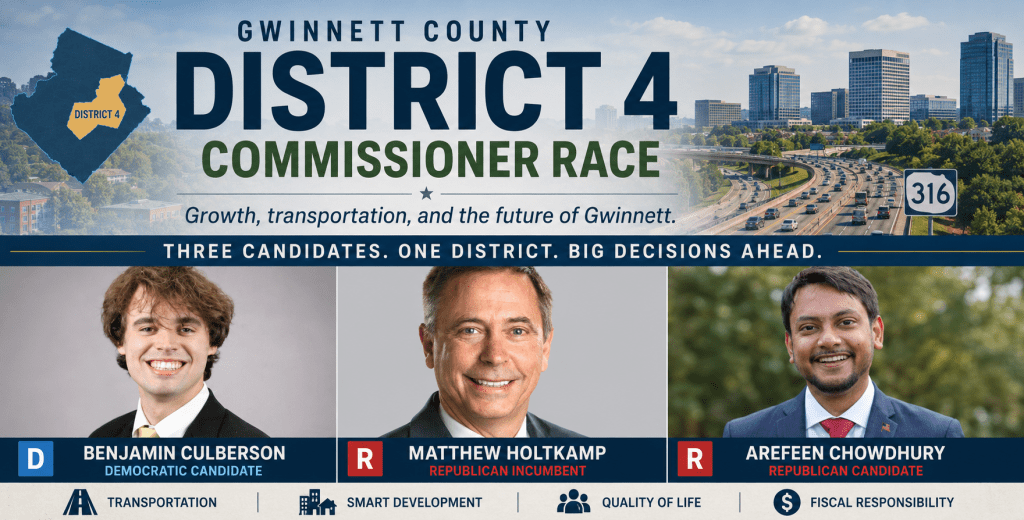
The Gwinnett County Commission District 4 race may not be getting the same attention as some national political fights, but the decisions made in this district over the next few years could shape daily life in Gwinnett County for decades.
Transportation. Traffic congestion. Development. Housing. Infrastructure. The future of areas surrounding the Highway 316 corridor and the continuing pressure of growth across Gwinnett are no longer abstract policy debates. Residents are seeing these issues play out in real time every day on crowded roads, at zoning meetings, and in conversations about what kind of county Gwinnett is becoming.
This year, District 4 voters will eventually choose between three candidates: incumbent Republican Commissioner Matthew Holtkamp, Republican challenger Arefeen Chowdhury, and Democrat Benjamin Culberson.
For now, however, the immediate focus is on the Republican primary.
(more…) -
America’s Burden: A More Honest Accounting
Modern discussions of post-colonial conflict often settle into a comfortable narrative: the United States intervened, therefore the United States caused the tragedy. American policy deserves serious criticism in Vietnam, Cambodia, and elsewhere — but this interpretation flattens history and, in doing so, actually lets other guilty parties off the hook.
The foundational damage was done before Washington became the dominant outside power in most of these places.
In French Indochina, colonial authorities chose to reassert control after Japan’s collapse rather than negotiate a genuine independence settlement with Ho Chi Minh’s nationalist movement in 1945–46. That decision ignited the First Indochina War. France lost it at Dien Bien Phu in 1954, then departed — leaving behind weak institutions, divided societies, and an artificially drawn partition at the 17th parallel that guaranteed future conflict. The United States inherited a mess it did not create.
Haiti’s story is even more instructive. After the successful slave revolt of 1804 — one of the most remarkable acts of human liberation in recorded history — France extorted a crushing indemnity in 1825: 150 million francs backed by the threat of naval invasion. Haiti paid that odious debt for over a century, hemorrhaging wealth and borrowing from French banks to do it. This was not American imperialism. It was European gunboat diplomacy aimed at punishing a Black republic for the crime of existing.
These colonial legacies — extractive economies, artificial borders, broken institutions, and accumulated resentment — created states ill-equipped for the chaos of decolonization. Those fractures were already there when the Cold War arrived.
The Cold War transformed regional crises into global strategic contests. By the early 1950s, Soviet consolidation of Eastern Europe, the communist victory in China, and North Korea’s invasion of the South had convinced American policymakers that unstable regions were genuinely vulnerable to hostile takeover. The Domino Theory was not pure paranoia — it was a reasonable, if imperfect, reading of recent events. The United States entered Korea under a UN mandate and ultimately preserved a South Korean state that became a prosperous democracy. Whatever one thinks of how the Cold War was fought, the threat that animated American strategy was real.
That said, American policy was neither wise nor morally clean.
In Vietnam, successive administrations underestimated the nationalist dimension of the conflict, overestimated the competence of their South Vietnamese partners, and escalated a war they could not define politically or win militarily. The bombing campaigns in Cambodia contributed to the instability that helped the Khmer Rouge recruit and consolidate power. Throughout the Cold War, Washington supported authoritarian governments whose anti-communism mattered more to American strategists than democratic legitimacy. These choices carried immense human costs — millions dead across Indochina, lasting environmental damage from chemical defoliation, and profound erosion of domestic trust inside the United States itself.
These failures deserve honest reckoning. But assigning primary responsibility for every resulting catastrophe to the United States alone requires ignoring everyone else in the room.
North Vietnam pursued unification through total war with substantial Soviet and Chinese backing. The Khmer Rouge were not passive byproducts of American bombing — they were radical Maoists driven by their own ideological program, supported by China, who carried out a genocide on their own people. South Vietnam’s endemic corruption hollowed out its own military from within. In Haiti, generations of predatory local elites and coups compounded the damage long after the French debt was retired. Local agency — including the agency of revolutionary movements and authoritarian governments alike — shaped these outcomes in ways no outside power could fully control.
The broader Cold War record is also not uniformly dark. American security commitments and economic support contributed to the reconstruction of Western Europe and Japan, and to the long-term stability of South Korea and Taiwan. The open trading system Washington helped build contributed to the largest reduction in global poverty in human history. These outcomes matter too.
A genuinely critical view of American power has to be historically precise to be credible. Treating the United States as the sole author of post-colonial instability doesn’t just misread history — it absolves European empires of the wreckage they left behind, minimizes the crimes of communist regimes, and erases the choices made by local leaders and movements who had their own ambitions and their own agency.
The honest account holds several things at once: European colonialism created the underlying fractures. Chaotic decolonization lit the fuse. Communist powers actively pursued expansion. Local governments and revolutionary movements made consequential choices of their own. And the United States, attempting to contain rivals and preserve influence, sometimes stabilized regions and sometimes deepened existing disasters.
That is not a story of American innocence. But it is not a story of unique American guilt either. It is the story of a turbulent century in which collapsing empires, ideological warfare, and great-power competition collided across fragile states — with devastating consequences that no single actor caused and no simple narrative can explain.
-
Evaluating Judges: A Voter’s Guide to Performance Indicators
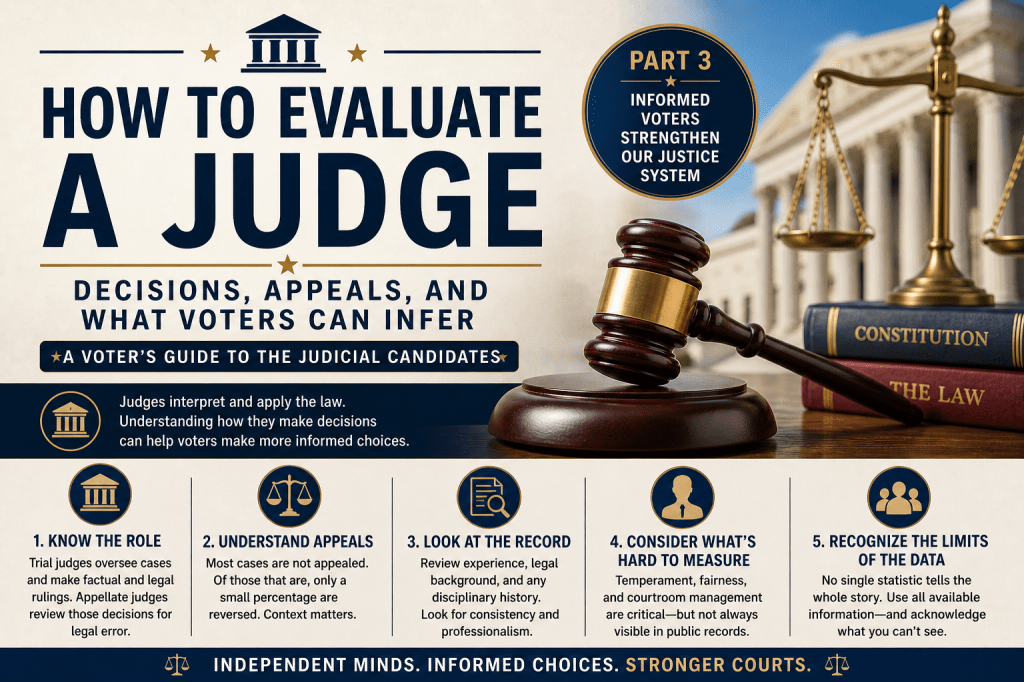
In Part 1, we looked at who the candidates are. In Part 2, we examined what the public record shows about professional conduct.
That leaves the hardest question: how do you evaluate a judge’s actual work?
Unlike legislators, judges do not campaign on policy positions. Their work is found in rulings, courtroom decisions, and how those decisions hold up under review.
For most voters, that information is difficult to access and even harder to interpret. This guide aims to explain what can reasonably be evaluated—and what cannot.
(more…) -
Judicial Candidates: What the Records Show
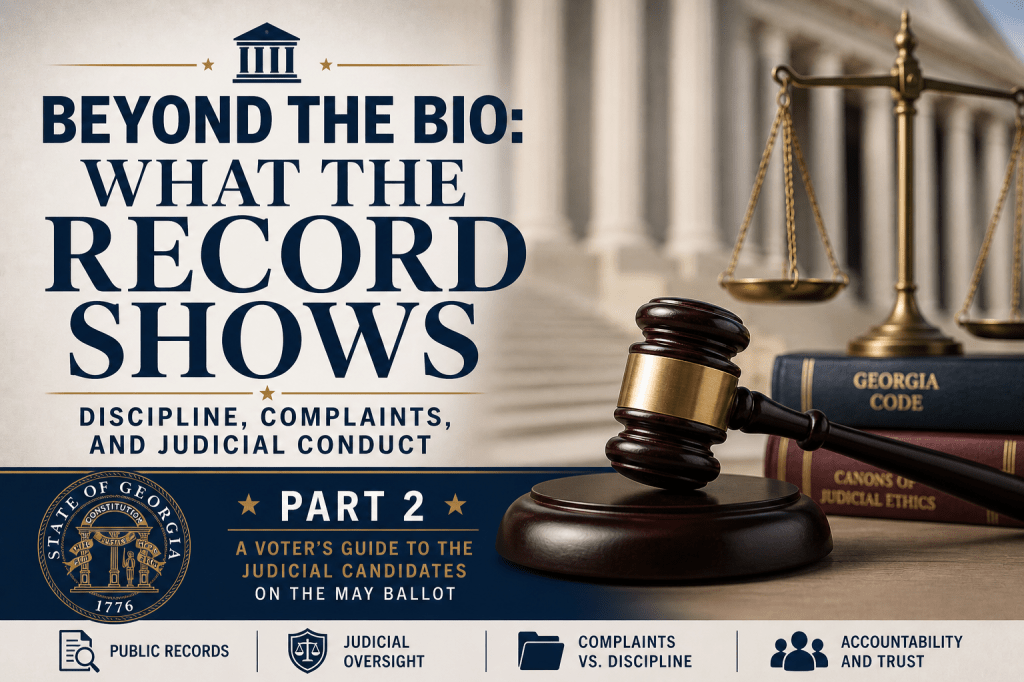
In Part 1, we looked at who the judicial candidates are and their professional backgrounds. The next question is just as important: what does the public record say about how they have conducted themselves as attorneys and judges?
This is where things can get confusing for voters. Terms like “complaints,” “discipline,” and “ethics violations” are often used interchangeably, but they do not mean the same thing.
This article focuses only on public, verifiable disciplinary records. It does not rely on rumors, allegations, or unverified claims.
(more…) -
Who’s on the Bench: A Voter’s Guide to Judicial Candidates on the May Ballot
Most of us don’t spend a lot of time thinking about judicial races. There are no party labels, very little campaigning, and often very little information. Yet these are the people who will make decisions that affect property, liberty, and in some cases, life itself.
This guide is not an endorsement of any candidate. It is simply an effort to lay out who is on the ballot, what their professional background looks like, and how they got to where they are.
The information below is drawn from publicly available records and the May 2026 ballot . In some cases—particularly with challengers—public information is limited. Where that is the case, it is noted.
(more…)
Things I think about things I see
[
[
[
]
]
]

