
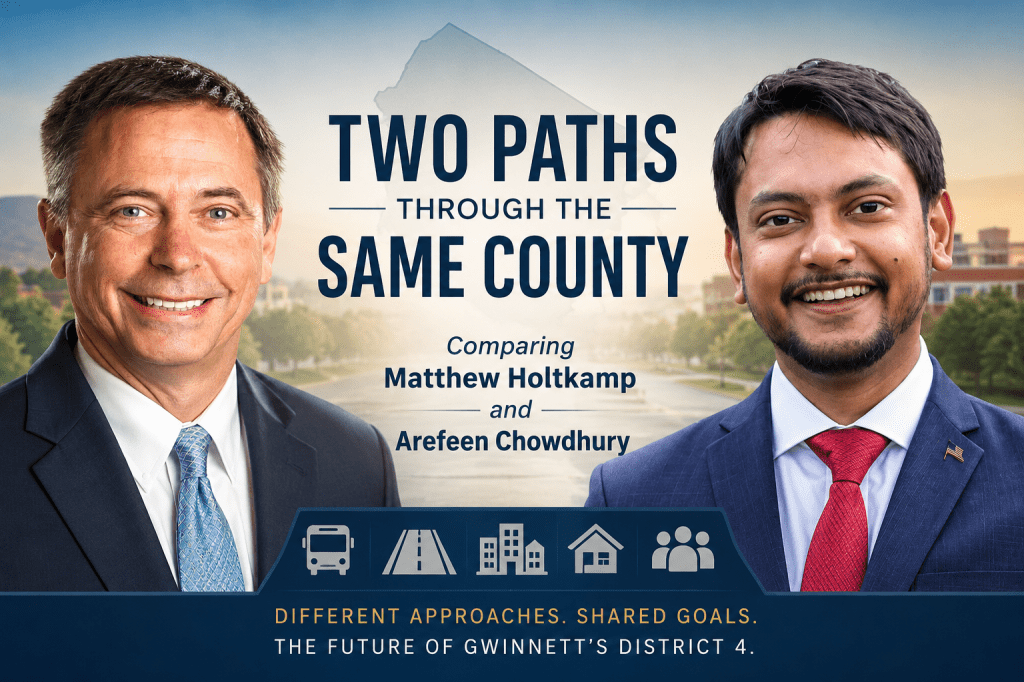
Gwinnett County Commission District 4 may be one of the more interesting local races on the ballot this year — not because the candidates are radically different, but because in many ways they are surprisingly alike.
The more I’ve looked into incumbent Matthew Holtkamp and challenger Arefeen Chowdhury, the less this race looks like a battle between opposites. Instead, it increasingly feels like two men approaching the same problems from different directions and arriving near the same destination.
That may frustrate people looking for a loud ideological clash. Personally, I think it says something important about where Gwinnett County is heading.
The county’s biggest issues are no longer abstract political arguments. They are practical realities. Traffic congestion. Infrastructure strain. Housing pressure. Development patterns. Transportation. Public services trying to keep pace with explosive growth. These are management problems as much as ideological ones.
Both Holtkamp and Chowdhury appear to understand that.
Where they differ is less in what they see and more in how they seem inclined to respond to it.
Holtkamp comes across as an institutional pragmatist. After speaking with him and reviewing his public record, what stands out most is his focus on constituent services and operational government. He strikes me as someone who believes government works best when it functions consistently, predictably, and accessibly. He speaks highly of microtransit and believes Gwinnett’s existing bus system is often underrated for what it manages to accomplish under difficult conditions.
There is a practical streak to his thinking. Improve what already exists. Expand carefully. Build on systems that already function instead of tearing them apart and starting over.
Chowdhury, meanwhile, appears to approach many of the same issues from a more future-oriented direction. In my interview with him, it was clear he has spent serious time thinking about transportation, growth, and infrastructure. He does not come across as someone dismissive of transit or long-term planning. If anything, he seems focused on how Gwinnett adapts to the county it is becoming rather than the county it used to be.
That distinction matters.
Gwinnett cannot widen roads forever. At some point transportation, land use, housing, and economic development all begin interacting with one another whether county government plans for it or not. Both candidates appear to recognize that reality even if their governing instincts differ.
And that may be the real heart of this race.
Holtkamp feels like a steady hand inside the current system. Chowdhury feels more like someone interested in shaping what the next version of that system could become.
Those are not mutually exclusive visions.
In fact, what makes this race unusual is how little either candidate resembles the caricatures people often expect in modern politics. Neither man strikes me as particularly ideological. Neither appears interested in turning county government into a partisan battlefield. Both seem more grounded in administration, planning, and practical governance than in political theater.
That is increasingly rare.
The contrast here is less left versus right and more experience versus fresh perspective. Operational pragmatism versus structural adaptation. Refinement versus evolution.
Voters may ultimately decide they prefer the experience and familiarity of Holtkamp. Others may decide Gwinnett’s growth pressures require newer approaches and different instincts. Both are legitimate arguments.
But after spending time researching this race, I do not think District 4 voters are choosing between two radically different futures. I think they are choosing between two different routes through the same rapidly changing county.
And honestly, that may say more about Gwinnett’s political future than either campaign realizes.


Leave a comment