
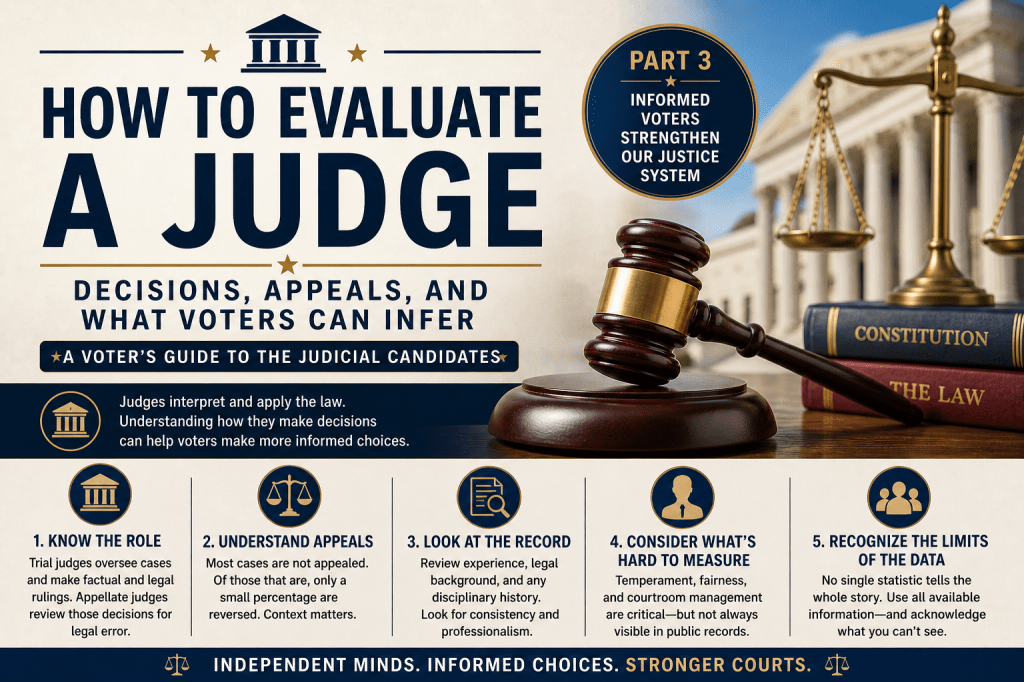
In Part 1, we looked at who the candidates are. In Part 2, we examined what the public record shows about professional conduct.
That leaves the hardest question: how do you evaluate a judge’s actual work?
Unlike legislators, judges do not campaign on policy positions. Their work is found in rulings, courtroom decisions, and how those decisions hold up under review.
For most voters, that information is difficult to access and even harder to interpret. This guide aims to explain what can reasonably be evaluated—and what cannot.
⚖️ Trial Courts vs. Appellate Courts
Not all judges do the same job.
- Trial court judges (Superior and State Court) oversee cases, manage courtrooms, rule on evidence, and issue decisions in real time.
- Appellate judges (Court of Appeals and Supreme Court) review those decisions for legal error.
Because their roles are different, they cannot be evaluated the same way.
🏛️ Evaluating Appellate Judges
For appellate courts, the concept of an “overturned ruling” is often misunderstood.
Appellate judges are already reviewing lower court decisions. Their rulings are rarely overturned, and when they are, it is typically by a higher court on complex legal questions.
Instead of reversal rates, more meaningful indicators include:
- Clarity of legal reasoning
- Consistency across cases
- Participation in majority vs. dissenting opinions
- Areas of legal focus (criminal, civil, constitutional)
These factors help show how a judge approaches the law, even if they do not produce simple metrics.
⚖️ Evaluating Trial Judges
Trial judges can be evaluated in part through the appellate process—but with caution.
What Appeals Actually Measure
When a case is appealed:
- A higher court reviews whether the law was applied correctly
- Only a small percentage of cases are appealed
- An even smaller percentage are reversed
This means that any “reversal rate” reflects:
- A small and selective sample of cases
- Often the most complex or disputed matters
A More Useful Way to Look at It
When data is available, it is more accurate to frame it like this:
Out of the cases that were appealed, how many were affirmed versus reversed?
Even then, context matters:
- Criminal cases are appealed more frequently than civil cases
- High-volume judges will naturally have more appeals
- Complex cases are more likely to produce reversals
A reversal does not automatically indicate a poor decision—it may reflect a close legal question.
📊 What Voters Can Reasonably Infer
Even with limited data, voters can look for patterns:
1. Experience in the Type of Law They Judge
- Trial-heavy courts benefit from judges with courtroom experience
- Appellate courts benefit from strong legal writing and analysis
2. Professional Stability
- Consistent career progression
- No disciplinary history (as discussed in Part 2)
3. Breadth of Legal Background
- Prosecutors, defense attorneys, and civil litigators bring different perspectives
- No single background is inherently better, but it shapes how a judge sees cases
4. Appointment vs. Election History
- Many judges are initially appointed and later run to retain their seat
- This can affect how much public information is available about them
⚠️ What Voters Cannot Easily Measure
Some of the most important qualities of a judge are also the hardest to quantify:
- Judicial temperament
- Fairness in the courtroom
- Ability to manage complex cases
- Respect for both sides in a dispute
These qualities are rarely captured in public statistics.
⚖️ The Difference Between Judgment and Opinion
One of the most difficult aspects of evaluating judges is separating personal belief from judicial responsibility.
Judges are not elected to decide what they personally think is right or wrong. Their role is to interpret and apply the law as written, within the limits of the constitution.
In some cases, this may require a judge to issue a ruling that does not align with their personal views. The decision reflects their interpretation of the law—not necessarily their individual opinion.
For voters, this can make judicial decisions harder to evaluate. A single ruling, especially in a controversial case, may say more about how a judge understands their role than it does about their personal beliefs.
Understanding this distinction can help provide context when reviewing a judge’s record.
🧭 A Practical Approach for Voters
Given the limits of available information, a practical approach is:
- Confirm baseline qualifications
- Legal experience
- Relevant background
- Check for disciplinary history
- Public records from oversight bodies
- Look for reasons for concern
- Notable controversies
- Patterns of unusual outcomes
- If no clear concerns emerge, recognize the limits of available data
In many races, particularly those without challengers or with limited public information, voters are working with incomplete information. Acknowledging that limitation is part of making an informed decision.
Closing Thoughts
Judicial elections ask voters to make decisions about candidates whose work is often technical, detailed, and largely out of public view.
There is no single statistic or shortcut that can fully evaluate a judge. Instead, voters are left to piece together background, professional conduct, and limited indicators of performance.
This series has aimed to provide a clearer picture of those elements. While it does not offer recommendations, it is intended to give voters a more informed starting point as they approach the ballot.
 The musings of Larry D Burton
Leave a comment