
By Larry D. Burton
Picture a man in his late sixties. He was a carpenter for forty years—strong hands, precise movements, a craftsman’s pride in what those hands could do. Now he sits across from his neurologist and receives a diagnosis that will spend the next decade systematically dismantling everything he was. His hands will shake. His balance will betray him. His face will lose its expressiveness. His voice will fade to a whisper.
Parkinson’s disease has no cure. It has no therapy that stops it. It can be managed, slowed somewhat, made marginally more bearable—but it cannot be defeated.
Now imagine that somewhere in the medical literature, buried under decades of institutional indifference, there exists a signal—consistent, replicated, peer-reviewed—suggesting that a common molecule may protect the very neurons his disease is destroying.
Imagine that signal has been sitting there, largely ignored, since 1959.
That is not a hypothetical. That is where we are.
The Signal Nobody Wanted to Hear
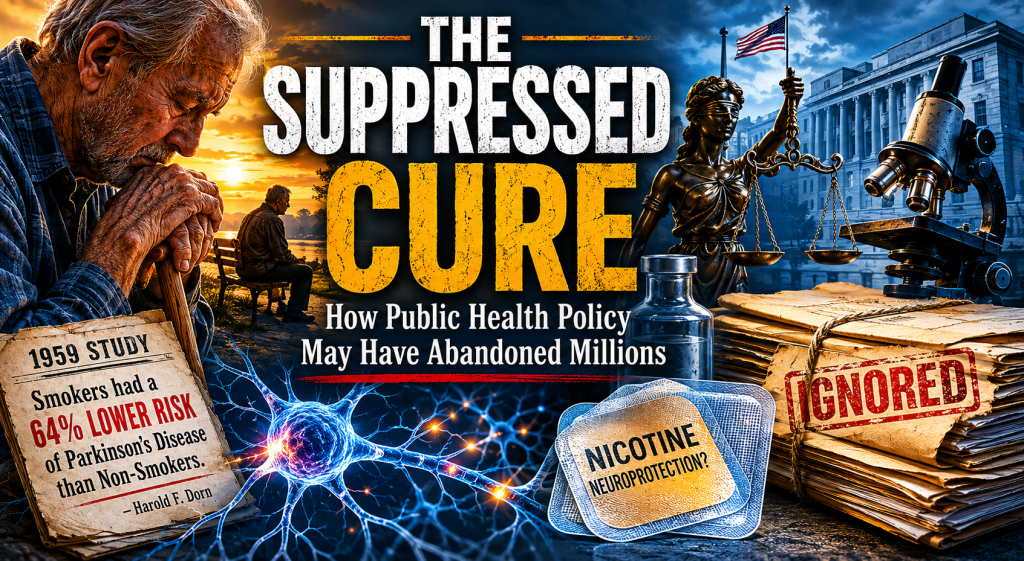
In 1959, Harold F. Dorn of the United States Public Health Service published a landmark mortality study analyzing nearly 200,000 veterans. The headline findings confirmed what researchers suspected: smoking increased the risk of dying from lung cancer and cardiovascular disease. But buried in the data was something nobody expected and almost nobody talked about. Smokers had a 64 percent lower risk of dying from Parkinson’s disease than non-smokers.
The finding was anomalous, inconvenient, and quickly overshadowed by the cancer data. But it didn’t go away.
Over the following six decades, the inverse association between smoking and Parkinson’s disease was replicated across dozens of studies on multiple continents, using different methodologies, different populations, and different analytical frameworks. It showed a duration-dependent effect—the longer a person smoked, the lower their Parkinson’s risk appeared. It was, by any reasonable scientific standard, one of the most consistently reproduced observations in modern epidemiology.
Similar signals began emerging for Alzheimer’s disease. Peer-reviewed research documented nicotine’s measurable effects on attention, working memory, and long-term memory, and its potential protective effects under the neurological conditions that define both diseases.
The science was real. The signal was clear. The biological mechanism was plausible.
And for sixty-seven years, the research establishment looked the other way.
This Is Not Fringe Science
Before dismissing this as the wishful thinking of tobacco apologists, understand what the underlying biology actually says.
Nicotine binds to nicotinic acetylcholine receptors distributed throughout the brain. These receptors are involved in the regulation of dopaminergic neurons—the precise cells that Parkinson’s disease systematically destroys. Animal model studies have shown that nicotine can slow the degeneration of these neurons and improve behavioral outcomes in subjects with Parkinson’s-like conditions. Peer-reviewed research published in the National Library of Medicine has documented nicotine’s benefits across multiple pathological conditions including Alzheimer’s disease, Parkinson’s disease, schizophrenia, and stress-induced depression.
This is not folk medicine. This is not the tobacco lobby cooking numbers. This is published, peer-reviewed biology pointing toward a molecule that may do something remarkable in the human brain—and it has been pointing that way for generations.
The Establishment’s Counter-Narrative
Skeptics within the public health apparatus have spent decades trying to explain this signal away. They point to survival bias, arguing that smokers simply died of cardiovascular disease or lung cancer before reaching the age when Parkinson’s typically manifests. They propose reverse causality, suggesting that the very early, pre-symptomatic stages of Parkinson’s naturally rob the brain of its dopamine-driven response to nicotine, making it incredibly easy for future patients to quit smoking or never start.
These academic caveats, however, miss the broader, more damning point. Instead of aggressively funding the basic and clinical science required to untangle these hypotheses and isolate a potential lifesaver, the public health establishment used them as convenient excuses to change the subject.
When trials finally were conducted—such as the major, belated NIC-PD study, which found that standard transdermal nicotine patches failed to arrest late-stage degeneration—they arrived decades too late, often testing the molecule on patients whose neurological damage was already irreversible. An underpowered or poorly timed trial is not evidence that a molecule is a failure; it is evidence of a research framework that lacked the courage to optimize it.
How the Suppression Happened—Without a Conspiracy
Nobody made a phone call. Nobody killed a study in the night. What happened was something more insidious and in some ways more damning: the research was quietly starved of oxygen by institutional incentives that made pursuing it professionally and politically untenable.
The gatekeepers of medical research funding—the National Institutes of Health, the Centers for Disease Control, the major cancer institutes—operate within a public health framework built on a single overriding message: tobacco kills. That message is not wrong. But it is incomplete. And the institutions that manage it have spent decades ensuring it stays simple.
Researchers know how funding works:
- A grant proposal exploring the neuroprotective properties of nicotine in Parkinson’s patients doesn’t fit the approved narrative.
- It generates institutional friction.
- It creates political liability.
- It hands public relations ammunition to an industry the public health establishment spent decades fighting in the courts and the courts of public opinion.
The Moral Accounting
Let the numbers sit for a moment.
More than one million Americans currently live with Parkinson’s disease. Fifty-five million people worldwide are living with Alzheimer’s. Both diseases are progressive and incurable. Both strip their victims not just of life but of self—of the ability to move, to speak, to remember, to recognize the faces of people they love.
The combined direct and indirect cost of Parkinson’s alone in the United States—treatment, Social Security payments, lost income—was calculated at $82.2 billion in 2024. The human cost does not have a number.
Against that backdrop, consider what we are talking about. Not a cure. The epidemiological data does not promise a cure. What it suggests is a neuroprotective effect—the possibility of slowing the advance of the disease, of buying years of mobility and cognition for patients who otherwise have none to buy. Even a therapy that merely delayed progression by five years would transform the quality of life for millions of people and their families.
That possibility has been sitting in the scientific literature since the Eisenhower administration. Now ask the question that demands to be asked: who decided that tobacco’s political toxicity outweighed the suffering of those millions of people?
The honest answer is that nobody decided. It happened by default. It happened through the quiet accumulation of institutional cowardice—not malice, not conspiracy, but the ordinary human tendency to avoid professional risk, protect established narratives, and let sleeping dogs lie.
That is not an exoneration. In the face of this scale of human suffering, institutional cowardice is a moral failure. The absence of a decision is itself a decision. And the patients who spent the last sixty-seven years waiting for a therapy that was never seriously pursued deserved better than to be the collateral damage of a political fight about cigarette advertising.
The Damage Extends Beyond Parkinson’s Patients
There is a secondary harm here that reaches far beyond the neurology ward, and it is one that the public health establishment seems constitutionally unable to see.
When the public discovers—and they do discover, in the age of the internet, they always eventually discover—that the official scientific narrative was incomplete, that inconvenient findings were systematically de-emphasized not because the science was wrong but because the politics were complicated, trust erodes. Not just in tobacco science. In all of science.
Climate change deniers point to exactly this kind of episode. Anti-vaccine advocates point to exactly this kind of episode. Conspiracy theorists of every variety are sustained and legitimized by the real and documented history of scientific establishments managing findings rather than following them. They don’t distinguish between “the tobacco research literature was incomplete due to funding bias” and “climate data is fabricated.” It all collapses into a single corrosive narrative: you cannot trust the experts.
The public health establishment’s commitment to message discipline—its decision to protect the smoking cessation narrative at the cost of scientific completeness—may have done more long-term damage to public trust in science than publishing the complicated truth would ever have done. People are more resilient to nuance than the institutions managing them give them credit for. They are far less forgiving of the discovery that they were managed.
Science’s authority rests on a single premise: that it follows evidence wherever it leads, regardless of the political consequences. Every time it is caught following policy instead, that authority diminishes—and it diminishes not in one domain but across all of them.
What Must Happen Now
The ask here is not complicated. It does not require overturning decades of tobacco control policy. It does not require anyone to argue that smoking is safe. It requires only that we extend to nicotine the same scientific seriousness we extend to any other molecule that has shown consistent, replicated, biologically plausible promise in the treatment of devastating disease.
Specifically:
- The National Institutes of Health should fund large-scale, adaptive clinical trials of nicotine as a neuroprotective agent. These must focus on early-intervention windows and alternative delivery methodologies—not just standard patches, but systems that match the pharmacokinetics required to truly replicate the epidemiologic signal.
- The Parkinson’s Foundation, the Michael J. Fox Foundation, and the Alzheimer’s Association must double down on their institutional weight to demand this targeted research. These organizations exist to serve their patients, not to protect the political consensus of the public health establishment.
- Congress should direct NIH specifically to fund nicotine neuroprotection research as a distinct priority—named, allocated, and accountable—so it can no longer be quietly deprioritized in general neurology budgets.
The Close
The carpenter with the shaking hands is not a metaphor. He is ten million people. He is the parent who can no longer button a shirt, the grandmother who can no longer recognize her grandchildren, the retired teacher who spends the last years of his life imprisoned in a body he no longer controls.
The 1959 study that first observed the protective association between smoking and Parkinson’s disease is older than most of the patients currently suffering from it. Harold Dorn published his findings when Dwight Eisenhower was in the White House. We have had sixty-seven years. We have had consistent replication across dozens of studies. We have had a plausible biological mechanism. We have had millions of patients.
What we have not had is the courage to follow the science.
That is not a scientific failure. Science did its job. The epidemiologists published their findings. The biologists identified the mechanism. The signal was there for anyone willing to look.
This is a failure of institutions. It is a failure of the funding bodies that decided political safety was more important than patients. It is a failure of the journals that found it easier to publish harm than benefit. It is a failure of the professional culture that made pursuing this research more trouble than it was worth.
The patients didn’t have the luxury of deciding it was more trouble than it was worth.
How many more will we sacrifice on the altar of institutional timidity before we decide that the science matters more than the politics?
That question is not rhetorical. It has an answer. And the answer is being written right now, one untreated patient at a time.
Larry D. Burton writes on Georgia politics and civic affairs at larrydburton.com.


Leave a Reply