
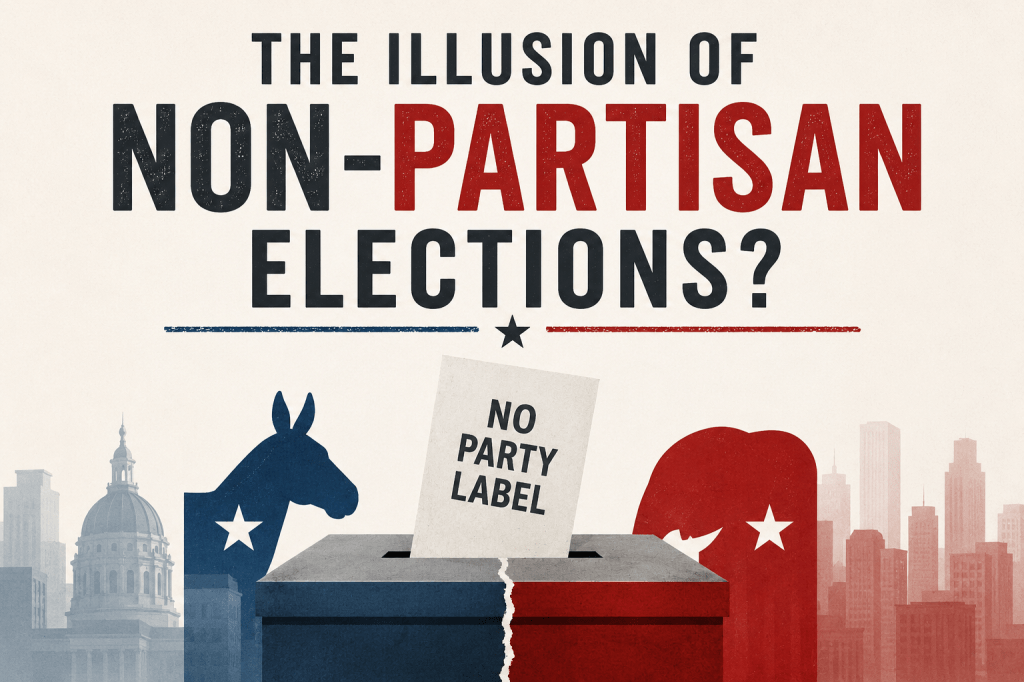
There is an idea buried inside Georgia House Bill 369 that I actually agree with.
In theory, local government should not function like cable news with zoning maps. County commissioners, sheriffs, and district attorneys are supposed to solve practical problems: roads, development, policing, budgets, emergency response. There is a reasonable argument that local offices should become less partisan, not more.
But HB 369 is not a serious attempt to create non-partisan government.
It is a selective, politically engineered half-measure that removes party labels from the ballot while leaving the actual party machinery completely untouched.
And that is the conundrum.
A “Statewide Principle” Applied to Only Five Counties
If non-partisan local government is truly good policy, then why is it being applied only to Gwinnett, Fulton, DeKalb, Cobb, and Clayton?
That question sits at the heart of the entire debate.
The legislature did not create a statewide standard. Instead, it used a narrow legal classification tied to counties with medical examiner systems — a mechanism that conveniently affects only a handful of metro Atlanta counties.
Supporters argue these counties are uniquely large and complex and therefore require a different model of governance. Maybe so. But if removing party labels improves elections, why are voters in Georgia’s other 154 counties apparently unworthy of the same reform?
That inconsistency makes this feel less like principled election reform and more like a carefully targeted political experiment.
It also raises a legitimate constitutional question that deserves more than a footnote. Georgia law prohibits “special legislation” — laws that target specific localities under the guise of general policy. The medical examiner classification is thin cover. If a future court looks at HB 369 and asks whether the legislature invented a classification specifically to reach these five counties rather than because the classification had independent legal meaning, the answer is not obviously “no.” That is a fragile foundation for restructuring local elections in Georgia’s most populous counties.
Non-Partisan Elections Without Real Ballot Access Are Mostly Theater
The deeper problem is that HB 369 changes the appearance of the ballot without changing the structure of political power.
Georgia still maintains some of the most restrictive ballot access rules in the country. Independent and third-party candidates remain at a severe disadvantage, both financially and structurally.
So what exactly changes under this new “non-partisan” system?
The Democratic and Republican parties will still recruit candidates. They will still fund candidates. They will still endorse candidates. They will still build turnout operations for candidates.
The only thing removed is the letter beside the candidate’s name.
That “D” or “R” will simply migrate from the ballot to campaign mailers, Facebook ads, text messages, slate cards, and whispered recommendations from political organizations.
In other words, the parties themselves are not disappearing. They are just becoming less transparent.
And voters are now expected to do additional homework just to recover information that used to be provided directly on the ballot.
That is not meaningful depoliticization. It is cosmetic depoliticization.
The Turnout Problem Nobody Wants to Discuss
There is another issue quietly lurking beneath all this: turnout.
For many of these local offices, the decisive election may effectively occur during the low-turnout spring cycle rather than in November, when the electorate is broader and more representative.
That matters.
A June runoff can easily become an election decided by a tiny, hyper-motivated slice of the population while the majority of voters are barely paying attention to local politics at all.
And in places like Gwinnett County, where rapid growth has already made local government harder for average residents to follow, shifting major decisions into lower-visibility election dates risks increasing public confusion rather than reducing polarization.
What Real Reform Would Look Like
I have argued elsewhere that the real structural fix is abolishing partisan primaries entirely in favor of a top-two open general election — one race, all candidates, every voter eligible, top two finishers advance regardless of party. That model forces candidates to compete for a broader electorate from the start rather than winning a low-turnout primary and coasting. It creates genuine competition without pretending parties don’t exist. HB 369 doesn’t get within shouting distance of that. It removes a label while leaving the primary system, the ballot access barriers, and the party infrastructure completely intact. You cannot reform the output while leaving the machinery alone and call it serious policy.
The Bottom Line
HB 369 doesn’t create non-partisan local government. It creates the appearance of non-partisan local government while handing a structural advantage to whoever is better organized, better funded, and better connected — which, in Georgia, means the established parties. Voters don’t gain transparency. They lose it. The parties don’t lose power. They gain cover. That’s not a tradeoff that benefits the public. It’s one that benefits the people who already run things.


Leave a comment