
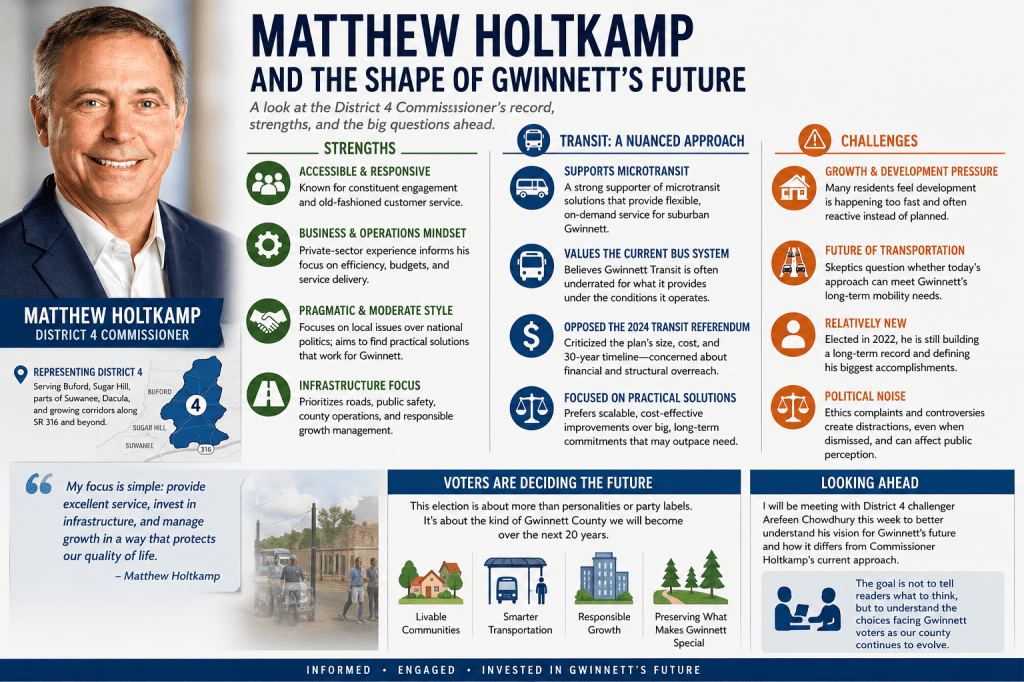
Gwinnett County Commissioner District 4 incumbent Matthew Holtkamp occupies an interesting political position in modern Gwinnett County politics. He is neither a bomb-throwing culture warrior nor a progressive urban planner. Instead, Holtkamp presents himself as a practical suburban commissioner focused on operations, infrastructure, public services, and controlled growth.
After spending time speaking with him directly, reviewing his public positions, and observing reactions from residents across District 4, one thing becomes clear: Holtkamp’s political identity is rooted more in management and responsiveness than ideology.
That approach may fit Gwinnett County at a time when many residents are exhausted by national politics but deeply concerned about growth, congestion, development, taxes, and quality of life.
A Commissioner Focused on Accessibility
One of Holtkamp’s strongest political assets appears to be constituent accessibility.
Whether one agrees with him politically or not, many residents describe him as responsive and approachable. In an era where many voters feel disconnected from government, that matters. County government often feels invisible until zoning changes appear nearby, traffic worsens, or infrastructure struggles to keep pace with growth.
Holtkamp appears to understand the value of direct engagement with residents. That old-fashioned style of local politics still carries significant weight in suburban counties like Gwinnett.
Transit: More Nuanced Than “For” or “Against”
Perhaps the most misunderstood aspect of Holtkamp’s record involves transit.
Holtkamp became widely known as the lone commissioner opposing Gwinnett’s 2024 transit referendum. That opposition led some residents to label him “anti-transit.” However, the reality appears more complicated.
Holtkamp is reportedly a strong supporter of microtransit solutions and has argued that Gwinnett’s existing bus system is often underestimated given the conditions under which it operates.
That distinction matters.
Microtransit generally focuses on smaller, flexible, on-demand transportation systems designed to serve suburban environments more efficiently than traditional fixed-route systems alone. In a county as geographically spread and automobile-oriented as Gwinnett, that argument has practical appeal to many voters.
His criticism appears less directed at transit itself and more toward large-scale, long-term transit expansion models that he believes may overreach financially or structurally.
At the same time, critics argue Gwinnett’s traffic congestion and rapid growth will eventually require more ambitious regional transportation solutions than microtransit and conventional buses alone can provide.
That debate is likely to define Gwinnett politics for years to come.
The Development Question
Like nearly every modern Gwinnett elected official, Holtkamp faces growing scrutiny over development and growth management.
Supporters see him as pro-business and focused on maintaining economic growth and county competitiveness. Critics worry Gwinnett’s development pace increasingly feels reactive rather than planned.
This may ultimately become the defining issue for District 4 and for Gwinnett County itself:
Can growth remain controlled, coordinated, and tied to infrastructure improvements — or will development continue to outpace transportation and quality-of-life planning?
That concern cuts across party lines.
Residents throughout northeast Gwinnett increasingly express interest in:
- preserving some remaining rural character,
- creating walkable mixed-use areas,
- improving transportation options,
- and ensuring development occurs intentionally rather than piecemeal.
Strengths and Vulnerabilities
Holtkamp’s strengths appear to include:
- constituent responsiveness,
- business and operational experience,
- a pragmatic public style,
- and an ability to avoid the more polarizing aspects of national politics.
His vulnerabilities likely include:
- voter frustration over continued rapid development,
- skepticism about whether current transportation approaches can scale with future growth,
- and the political reality that incumbents often absorb blame for broader county frustrations whether fully responsible or not.
Looking Ahead
District 4 voters are not simply deciding between personalities or party labels. Increasingly, they are deciding what kind of county Gwinnett should become over the next twenty years.
Should growth continue largely market-driven?
Should the county move more aggressively toward large-scale transit?
How much remaining undeveloped land should be preserved?
And how should Gwinnett balance economic expansion with livability?
Those questions will not disappear after this election.
I will be meeting with District 4 challenger Arefeen Chowdhury later this week to better understand his vision for the future of Gwinnett County and how it differs from Commissioner Holtkamp’s current approach.
The goal here is not to tell readers what to think, but to better understand the choices facing Gwinnett voters as the county continues to evolve.


Leave a comment