
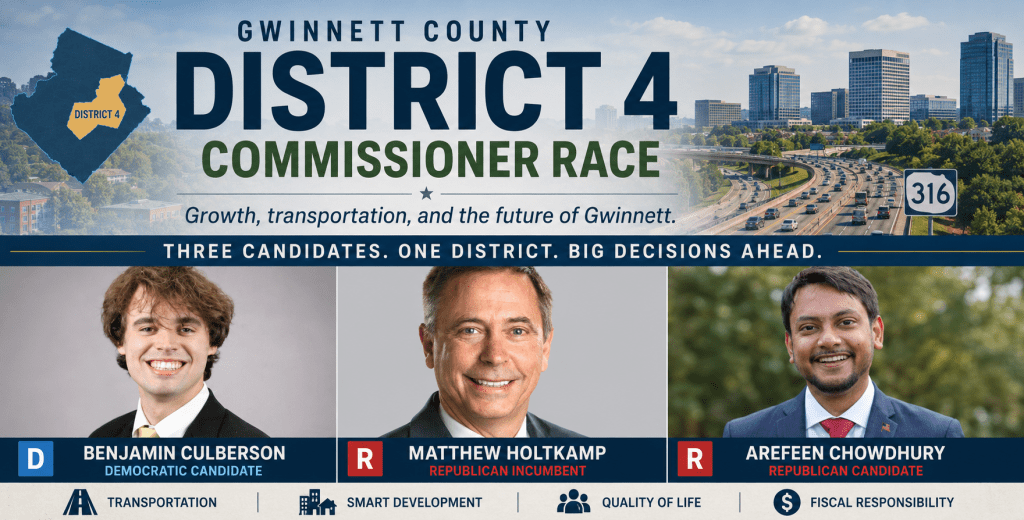
The Gwinnett County Commission District 4 race may not be getting the same attention as some national political fights, but the decisions made in this district over the next few years could shape daily life in Gwinnett County for decades.
Transportation. Traffic congestion. Development. Housing. Infrastructure. The future of areas surrounding the Highway 316 corridor and the continuing pressure of growth across Gwinnett are no longer abstract policy debates. Residents are seeing these issues play out in real time every day on crowded roads, at zoning meetings, and in conversations about what kind of county Gwinnett is becoming.
This year, District 4 voters will eventually choose between three candidates: incumbent Republican Commissioner Matthew Holtkamp, Republican challenger Arefeen Chowdhury, and Democrat Benjamin Culberson.
For now, however, the immediate focus is on the Republican primary.
Chowdhury is challenging Holtkamp in one of the few contested local Republican races in Gwinnett this cycle. Culberson faces no Democratic opposition in the primary and will advance directly to the general election, meaning voters will eventually see a broader countywide conversation about the future direction of District 4 after the Republican primary is settled.
The Incumbent
Holtkamp enters the race with the advantages that come with incumbency. Supporters frequently point to his constituent services and accessibility. In fact, some recent conversations I’ve had with residents suggest that Holtkamp has built a reputation for personally engaging with concerns raised by citizens.
I recently sat down with Commissioner Holtkamp for breakfast after he reached out regarding some of my own writing about Gwinnett growth and development issues. One thing that became clear during that conversation is that he pays attention to what residents are saying, particularly regarding development, transportation, and the county’s changing identity.
Still, incumbency always comes with questions.
As Gwinnett continues its rapid transformation, voters will have to decide whether they believe current growth patterns are being managed effectively or whether a different approach is needed. Fair or not, sitting commissioners often become the public face of both the successes and frustrations people associate with county government.
The Challenger
Chowdhury represents the unknown variable in the Republican primary.
At this stage, many voters likely know less about him than they know about the incumbent. That is often one of the biggest hurdles challengers face in local races. Campaign visibility, issue definition, and introducing themselves to voters become critical tasks.
I have a meeting scheduled with Chowdhury this coming week and intend to spend more time examining his policy positions, priorities, and vision for District 4 before publishing a deeper profile later this week.
One of the key questions surrounding this race will be whether Chowdhury is offering voters a fundamentally different vision for Gwinnett’s future or simply a different style of leadership.
Waiting Beyond the Primary
Because Culberson is unopposed in the Democratic primary, much of the immediate political attention is centered on the Republican contest. That does not make the general election unimportant. Far from it.
District 4 sits in the middle of many of the pressures shaping modern Gwinnett County. Questions about transit, density, zoning, economic development, preserving community identity, and maintaining quality of life are only becoming more important as the county grows.
The broader question voters may ultimately be deciding is not whether Gwinnett will continue to grow.
It will.
The real question is what kind of Gwinnett County is being built in the process.
This week I’ll be taking a closer look at the candidates themselves, beginning with Commissioner Holtkamp and then Chowdhury, before eventually turning toward the general election matchup later in the cycle.


Leave a comment