
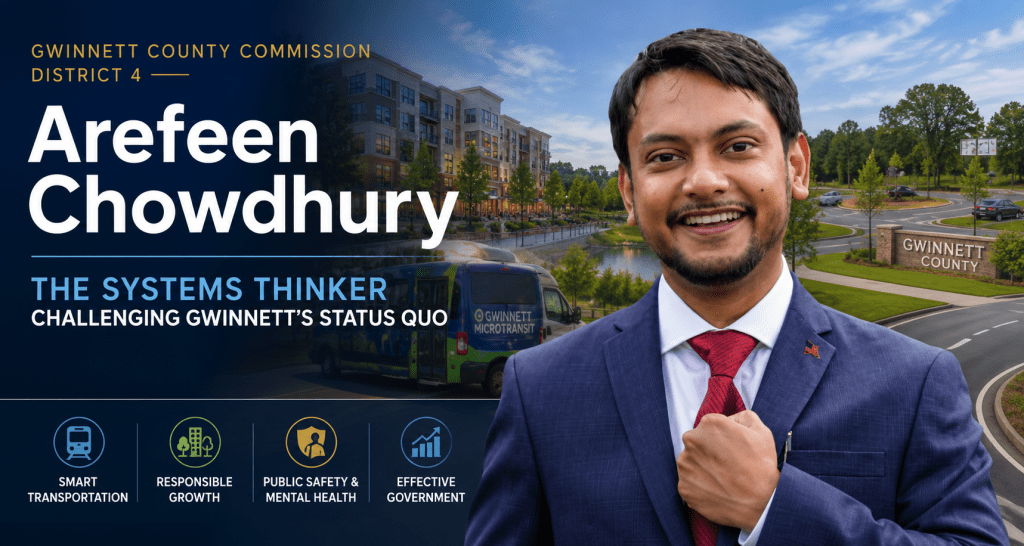
Gwinnett County Commission District 4 challenger Arefeen Chowdhury does not come across as a traditional politician.
After spending time speaking with him at length, the impression left is less “campaign speech” and more “operations manager.” Chowdhury talks about county government the same way a corporate executive talks about logistics, efficiency, staffing, customer service, and long-term planning.
Whether voters ultimately agree with him or not, one thing becomes clear quickly: he has spent serious time thinking about where Gwinnett is headed.
And just as importantly, where he believes it could go wrong.
Growth Without Direction
Like many residents, Chowdhury sees Gwinnett at a crossroads.
He repeatedly returned to one central concern during our conversation: growth is inevitable, but unmanaged growth can quietly erode quality of life.
Rather than opposing development outright, Chowdhury argues for what he calls “smart growth.” He points to the Rowen development corridor along Highway 316 as an example of the kind of planning Gwinnett should encourage moving forward — mixed-use developments where housing, jobs, retail, and services exist close enough together to reduce long commutes and endless traffic expansion.
His concern is not simply that Gwinnett is growing. His concern is how it is growing.
In his view, too much development has been allowed to outpace infrastructure, leaving roads overcrowded and long-time residents frustrated. He is particularly skeptical of dense housing projects being inserted into rural or agricultural areas without sufficient planning for roads, schools, grocery access, emergency response, or medical infrastructure.
Interestingly, he does not frame rural land preservation as anti-growth politics. Instead, he frames it as preserving options and preserving identity.
At one point, Chowdhury compared the need for long-term land preservation in Gwinnett to the foresight that created Central Park in New York City — the idea that some open spaces become more valuable precisely because development pressures continue increasing around them.
Transportation: More Than Just “More Roads”
Transportation may be the issue where Chowdhury appears most fully developed philosophically.
Unlike many local candidates who speak in broad terms about “traffic,” he talks specifically about:
- microtransit,
- last-mile connectivity,
- regional coordination with neighboring counties,
- automated traffic systems,
- roundabouts,
- commuter transit hubs,
- and tying future development directly to transportation infrastructure.
He is particularly enthusiastic about expanding Gwinnett’s existing microtransit system, arguing that many residents are unaware the service already exists. Rather than attempting to force traditional bus systems into low-density suburban areas, he favors a layered approach: smaller on-demand transit options locally, with larger commuter connections linking Gwinnett to Atlanta, the airport, and major employment centers.
His broader argument is simple:
Gwinnett cannot continue growing while relying entirely on the same car-centered infrastructure model that existed twenty years ago.
A Corporate Mindset Applied to Government
Chowdhury’s professional background clearly shapes how he views government.
Throughout our conversation, he repeatedly referenced:
- quarterly reviews,
- budget performance metrics,
- procurement efficiency,
- vendor competition,
- accountability standards,
- and customer-service responsiveness.
He believes county government has become too comfortable accepting inefficiency as normal.
To Chowdhury, government should not respond to residents with “that’s just how government works.” He argues that residents should expect faster responses, clearer communication, and more accountability from elected officials and county departments alike.
One promise he repeatedly emphasized was accessibility. He says constituents should not feel ignored or locked out of county government, and he committed himself to personally responding to concerns within 24 hours whenever possible — even if only to direct residents to the correct department.
Whether that standard proves realistic in practice remains to be seen, but it reflects the broader image he is trying to project: responsive, hands-on, and operationally focused.
Public Safety and Mental Health
On law enforcement issues, Chowdhury takes a position that may frustrate ideological purists on both sides.
He strongly supports law enforcement and speaks respectfully about officers throughout the discussion. At the same time, he argues that too many situations involving mental illness are currently being treated purely as criminal matters.
He supports expanded de-escalation training, mental-health intervention programs, and alternatives to repeatedly cycling mentally ill individuals through the jail system.
Importantly, he does not frame this as being “soft on crime.” Instead, he frames it as a practical recognition that untreated mental illness often drives repeat offenses and overwhelms law enforcement resources.
He also expressed mixed feelings about expanding surveillance technologies such as license plate tracking systems — acknowledging their usefulness while also raising civil-liberty concerns.
That balancing act may ultimately define much of his political identity: pro-public safety, but wary of overreach; pro-growth, but skeptical of uncontrolled development; pro-technology, but concerned about cybersecurity and privacy.
The Biggest Question Voters Must Answer
The strongest argument in Chowdhury’s favor may be that he clearly has ideas.
The biggest question surrounding his candidacy is whether those ideas can successfully translate into governing.
Unlike incumbent commissioner Matthew Holtkamp, Chowdhury does not yet have a commissioner voting record or executive governing history to point toward. Much of his campaign rests on vision, planning philosophy, and managerial approach.
For some voters, that may represent a refreshing alternative.
For others, experience and institutional familiarity may still matter more.
But after speaking with him directly, one thing is difficult to dismiss:
Arefeen Chowdhury is not approaching this race casually. He has thought deeply about Gwinnett’s future, and he clearly wants to be part of shaping it.
In a local political environment often dominated by slogans and surface-level campaigning, that alone makes him worth paying attention to.


Leave a comment