
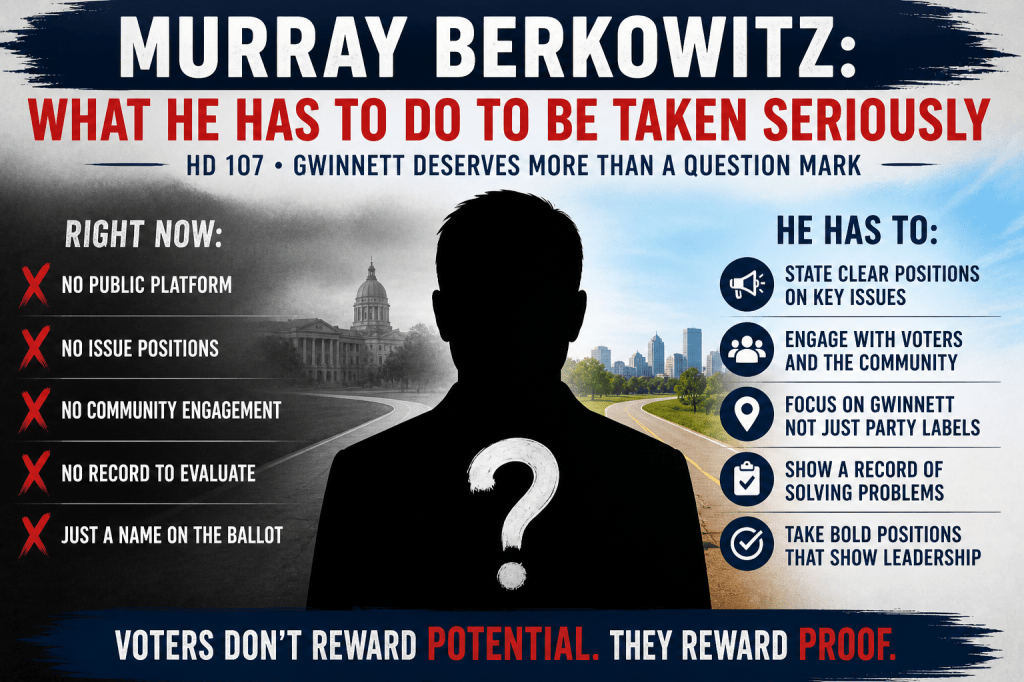
There’s still time for Murray Berkowitz to turn this into a real race.
But time alone won’t do it.
Right now, he’s not competing with Sam Park. He’s competing with a blank space—and voters don’t reward blank spaces.
If Berkowitz wants to be taken seriously—not just listed on a ballot, but actually considered—there are a few things he has to do. Not eventually. Now.
1. Pick a lane and say it out loud
This is the first test, and it’s the one most unknown candidates fail.
Voters don’t need a perfect platform. They need a clear one.
Right now, nobody knows:
- Where he stands on healthcare
- What he thinks about growth and development in Gwinnett
- How he approaches taxes, schools, or transportation
And in a district like this, “generic Republican” isn’t good enough.
Gwinnett isn’t static. It’s changing fast. If you’re running here, you’ve got to show you understand that—or you’ll get run over by it.
👉 Bottom line:
If voters have to guess what you believe, they’ll default to what they already know.
2. Show up where people actually are
A campaign isn’t a filing form. It’s presence.
Right now, Berkowitz is hard to find:
- No meaningful public engagement
- No visible outreach
- No consistent messaging
Meanwhile, voters are on:
- Nextdoor
- Local events
- Community meetings
If he’s not there, he’s not in the race.
👉 Bottom line:
You don’t get votes from silence.
3. Define yourself before your opponent does
If Berkowitz doesn’t define himself, Park’s record will define the entire race by default.
That’s a losing position.
A serious candidate answers this question early:
“Why am I a better choice for this district—specifically this district?”
Not:
- “I’m a Republican”
- Not: “I’ll bring change”
But:
- What kind of growth does he support?
- Does he want to slow development or shape it?
- What’s his stance on transit in a county that’s choking on traffic?
Gwinnett voters are practical. They care about what affects their daily lives.
👉 Bottom line:
If your message isn’t local, it’s irrelevant.
4. Prove you can do more than talk
Here’s the uncomfortable truth:
Anyone can run. Not everyone can govern.
Berkowitz needs to show:
- Professional background that translates to public service
- Evidence of problem-solving
- Some kind of track record—even outside politics
Because right now, Park’s biggest advantage isn’t ideology.
It’s that he’s already done the job.
👉 Bottom line:
Competence beats potential every time—unless you prove otherwise.
5. Take a position where it actually costs something
This is the one that separates real candidates from placeholders.
It’s easy to:
- Stay vague
- Avoid controversy
- Speak in generalities
It’s harder to:
- Take a stance that some voters won’t like
- Draw a clear contrast
- Risk losing support to gain credibility
But that’s exactly what earns respect.
👉 Bottom line:
If nothing you say offends anyone, nothing you say matters.
⸻
What Happens If He Doesn’t Do This
Let’s be honest about where this goes if nothing changes:
- Park keeps the advantage of a known record
- Berkowitz remains undefined
- Voters default to familiarity
And the race never really becomes a race.
⸻
The Opportunity (If He Takes It)
Here’s the flip side—and it’s real.
If Berkowitz:
- Defines himself clearly
- Engages voters directly
- Focuses on Gwinnett-specific issues
…then this becomes a legitimate contest. Not because of party. But because voters finally have something to compare.
⸻
Walking vs. Talking—Again
I’ve said before I watch how candidates walk. Right now, Berkowitz hasn’t stepped onto the road. That can change—but only if he decides to walk it in public. Because in politics, you don’t get judged on what you might be.
You get judged on what you show.
 The musings of Larry D Burton
Leave a comment