
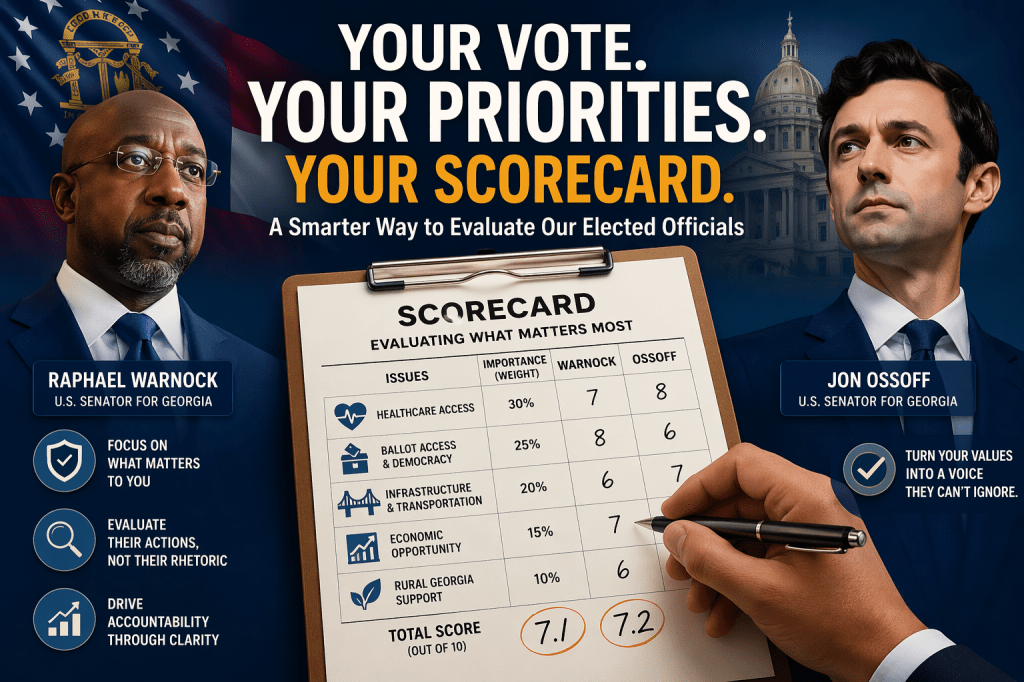
What if evaluating our elected officials didn’t have to feel like guesswork? Too often, voters rely on party labels, campaign slogans, or a handful of headline issues to decide who deserves their support. But there’s a better way—one that puts you, the voter, firmly in control. A personalized political scorecard can transform how you evaluate leaders like Raphael Warnock’s colleague Jon Ossoff and others who represent you.
The idea is simple: instead of asking whether a politician is “good” or “bad,” you define what matters most in your daily life and assign weight to those priorities. Then, you score elected officials based on how well their actions align with your values—not someone else’s talking points.
This approach cuts through the noise. It forces clarity. And most importantly, it turns passive voters into active evaluators of performance.
Building Your Personal Scorecard
Start by identifying the issues that genuinely impact your life. For many Georgians, that might include access to healthcare (especially in rural counties without hospitals), fair ballot access laws, infrastructure that supports pedestrians and cyclists, and the overall economic health of the state.
Next, assign each issue a weight. Not everything matters equally. If healthcare access is critical to you, it might account for 30% of your total score, while infrastructure or election reform might take smaller—but still meaningful—shares.
Finally, evaluate each official across those categories. Did they sponsor or support meaningful legislation? Did they advocate publicly? Did they deliver results, or just rhetoric? Score each category, multiply by your weights, and you’ll end up with a clear, personalized rating.
Why This Matters Now
In today’s political environment, it’s easy to feel like your voice is drowned out. National narratives dominate, while local concerns—like hospital closures or restrictive ballot access—get pushed aside. A personalized scorecard flips that dynamic. It forces accountability on the issues that affect your community directly.
It also exposes gaps. A politician might align with you on one major issue but fall short in others that matter just as much. Without a structured way to evaluate them, those shortcomings are easy to overlook.
From Opinion to Accountability
The real power of this system isn’t just personal clarity—it’s collective pressure. When more voters adopt transparent, issue-based evaluations, elected officials can no longer rely on vague messaging. They have to deliver measurable results.
Imagine walking into a town hall or writing your representative with a clear breakdown: “Here’s how you scored on the issues that matter most to me.” That’s a different conversation. That’s accountability backed by structure.
A Better Way Forward
This isn’t about favoring one party over another. It’s about raising the standard for everyone. Whether you’re evaluating Jon Ossoff, Raphael Warnock, or your local state representatives, the principle remains the same: performance should be measured against your priorities—not theirs.
If voters take this approach seriously, it could reshape how campaigns are run and how officials govern. Less theater. More results. Less guessing. More clarity.
And that’s a change worth making.
 The musings of Larry D Burton
Leave a comment