
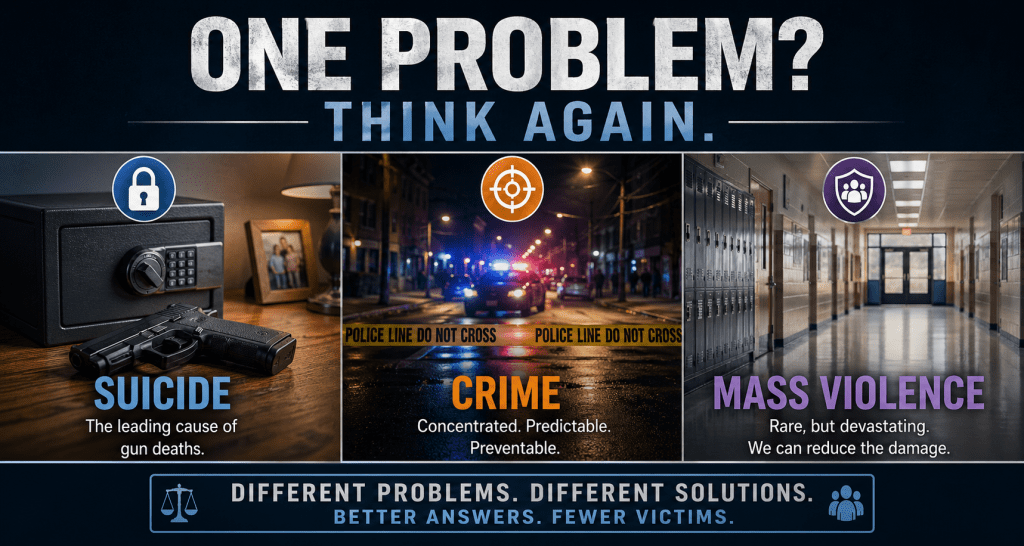
There’s a habit in this country that gets us in trouble over and over again—we take a complicated problem, flatten it into one thing, and then argue about one big solution like it’s going to fix everything.
Gun violence is a perfect example.
If you listen to the debate long enough, you’d think it’s all one issue. It’s not. It’s three very different problems wearing the same label—and if we don’t separate them, we’re just talking past each other.
1. The One Nobody Talks About: Suicide
This is the hard truth:
**Most gun deaths in America are suicides.**¹
Not crime. Not mass shootings. Quiet, personal decisions—often made in a moment that doesn’t last very long.
That matters because firearms are far more lethal than other suicide methods, which means attempts are much more likely to result in death.²
What actually helps here isn’t dramatic:
- Safe storage of firearms
- Temporary off-site storage during crises
- Waiting periods that introduce time between impulse and action
- Timely access to mental health care
Research consistently shows that means safety and time barriers reduce suicide deaths without requiring permanent restrictions.³
2. The Violence People Are Actually Seeing: Concentrated Crime
When people say “gun violence,” this is usually what they mean.
Here’s the reality:
Gun homicide is highly concentrated among a small number of individuals and locations, particularly in urban environments.⁴
Most gun homicides involve handguns, not rifles.⁵
That matters, because it tells us something important:
Broad, population-wide restrictions often miss the people most likely to be involved in violence.
What has shown stronger results:
- Focused deterrence strategies (“pulling levers”)
- Violence interruption programs
- Hot-spot policing (targeted, not blanket)
- Reentry and stability programs for high-risk individuals
These approaches are backed by multiple evaluations showing measurable reductions in violent crime when properly implemented.⁶
3. The One That Dominates the Headlines: Mass Shootings
Mass shootings account for less than 1% of total gun deaths in the United States.⁷
But they carry outsized impact—both in casualties and public fear.
Some research indicates that assault weapon bans and large-capacity magazine restrictions may reduce fatalities in mass shooting events, even if their effect on overall gun violence is limited.⁸
That’s an important distinction.
Policies in this space are less about total numbers and more about reducing the severity of worst-case scenarios.
So What’s the Real Problem?
We keep trying to use one solution for three different problems.
That doesn’t work—because each type of violence has different causes, different patterns, and different solutions.
What a Serious Approach Looks Like
A reasonable, evidence-informed approach would align solutions with the problem:
- Suicide prevention → safe storage, crisis intervention, waiting periods
- Homicide reduction → targeted enforcement and community-based intervention
- Mass shooting mitigation → focused policies addressing high-casualty risks
Final Thought
Anybody can promise to “solve gun violence.”
But if they can’t tell you the difference between these three problems—and how their plan addresses each one—they’re not ready for the job.
And we deserve better than that.
Footnotes
- Centers for Disease Control and Prevention, WISQARS Fatal Injury Reports, 2022–2024 data summaries.
- Harvard T.H. Chan School of Public Health, “Means Matter: Lethality of Suicide Methods.”
- National Institute of Mental Health, Suicide Prevention Research; see also RAND Corporation, The Science of Gun Policy.
- National Institute of Justice, studies on concentration of violent crime and repeat offenders.
- Federal Bureau of Investigation, Uniform Crime Reports (latest available tables on weapon types in homicides).
- National Institute of Justice and RAND Corporation, evaluations of focused deterrence and violence intervention programs.
- Congressional Research Service, reports on mass public shootings and firearm mortality.
- National Bureau of Economic Research; RAND Corporation, analyses of assault weapon bans and magazine capacity limits.
Selected Bibliography
- Centers for Disease Control and Prevention. Web-based Injury Statistics Query and Reporting System (WISQARS).
- Federal Bureau of Investigation. Uniform Crime Reports.
- National Institute of Justice. Firearm Violence and Prevention Research.
- RAND Corporation. The Science of Gun Policy: A Critical Synthesis of Research Evidence.
- Harvard T.H. Chan School of Public Health. Means Matter Campaign.
- Congressional Research Service. Mass Public Shootings Reports.
- National Bureau of Economic Research. Working papers on firearm policy effects.
- Braga, Anthony A., et al. “Focused Deterrence Strategies and Crime Control.” Criminology & Public Policy.
- Webster, Daniel W., et al. Research on gun policy and violence prevention.


Leave a Reply