
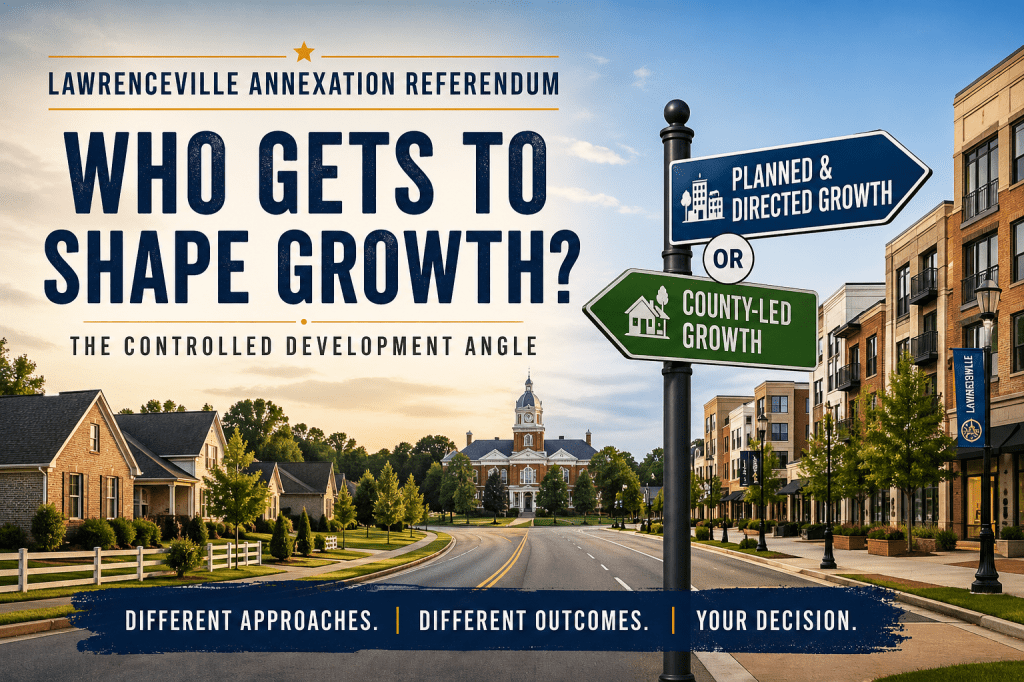
There’s a referendum coming up in Lawrenceville that hasn’t gotten nearly the attention it deserves. On the surface, it’s about moving some lines on a map. In reality, it’s about something much more practical:
Who gets to decide what gets built around you.
That’s the heart of this vote.
What’s Being Decided
Voters in parts of unincorporated Gwinnett County will decide whether their neighborhoods should be annexed into the City of Lawrenceville.
If approved, those areas would shift from county governance to city governance starting in 2027.
That means a different set of decision-makers will be calling the shots on zoning, land use, and development.
The Controlled Development Argument (The “Yes” Case)
Supporters of annexation aren’t really selling this as a tax story. They’re selling it as a control story.
Their argument goes something like this:
Lawrenceville, as a city, has a more focused interest in how land inside its borders is developed. City leaders tend to think in terms of:
- walkable areas
- mixed-use development
- redevelopment corridors
- long-term planning tied to infrastructure
In contrast, Gwinnett County has to manage growth across a much larger area with competing priorities.
The result, according to supporters, is that annexation gives residents a better shot at:
- shaping what gets built nearby
- avoiding poorly planned projects
- aligning development with a broader vision for the community
Put simply:
A smaller government unit can pay closer attention to what happens next door.
The Skeptic’s View (The “No” Case)
Opponents—or at least skeptics—don’t necessarily disagree that cities exercise more control.
Their concern is what that control leads to.
More structured planning can also mean:
- higher-density development
- rezoning that favors redevelopment
- pressure to “urbanize” areas that currently feel suburban
And once you’re in the city, those decisions are no longer made at the county level.
The concern here isn’t a lack of planning—it’s too much of the wrong kind.
There’s also a practical question:
Does being inside the city actually give residents more influence, or just a different set of decision-makers?
Because whether it’s city hall or the county commission, growth in Gwinnett isn’t stopping.
The Reality in Gwinnett
If you’ve lived here long enough, you already know the truth:
Growth is coming one way or another.
The real question isn’t if development happens—it’s how and who directs it.
Gwinnett County tends to:
- allow broader, sometimes faster suburban expansion
- approve projects across a wide geographic area
Cities like Lawrenceville tend to:
- concentrate development
- guide it through zoning overlays and redevelopment plans
- focus on creating identifiable “centers”
Neither approach is inherently right or wrong. They just produce different outcomes.
What This Vote Really Comes Down To
This referendum isn’t about whether you like development.
It’s about whether you want development shaped by:
- a large county system managing many priorities, or
- a smaller city government with a more targeted vision
A “yes” vote leans toward planned, directed growth.
A “no” vote leans toward continuing under the county’s broader approach.
Final Thought
Annexation debates can get wrapped up in taxes, services, and politics. Those matter, but they aren’t the core issue here.
This vote is about something more immediate:
When that empty lot down the road finally gets developed, who do you want making that call—and what kind of plan do you want them following?
That’s the decision in front of voters.
 The musings of Larry D Burton
Leave a comment