
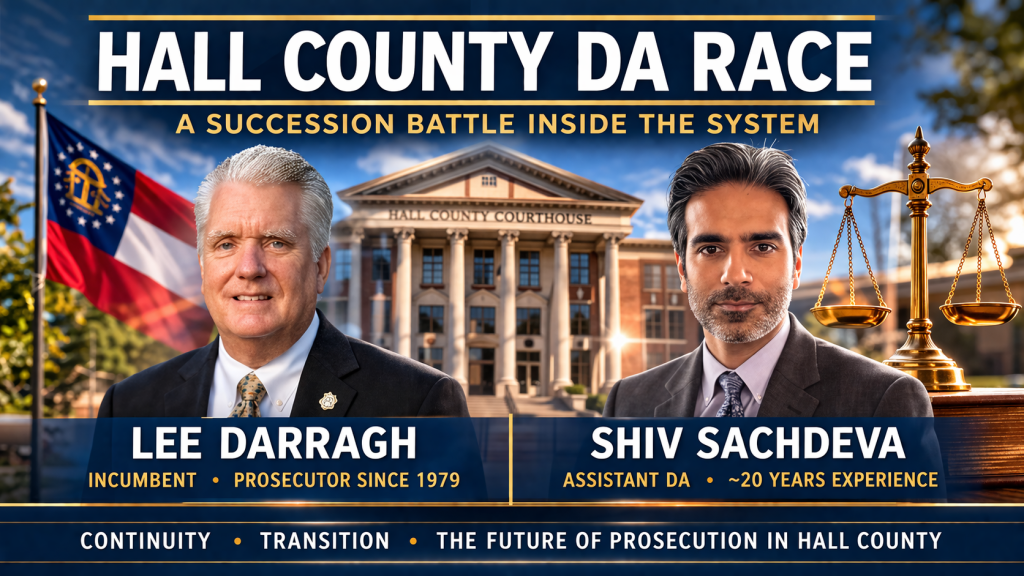
The race for District Attorney in Hall County, Georgia is not a typical partisan contest. There is no Democrat on the ballot, no ideological left-right showdown, and very little public policy disagreement on the surface.
Instead, this is a succession battle inside a long-established prosecutorial system—one that raises deeper questions about continuity, institutional power, and what “experience” actually means when one man has effectively shaped a courthouse for decades.
At its core, the contest between Lee Darragh and Shiv Sachdeva is less about competing visions of justice and more about who gets to define the next era of an already stable system.
A One-Party Race in Practice, Not Just in Name
Although the District Attorney’s office is technically nonpartisan, Hall County functions in practice as a one-party jurisdiction at this level. There is no Democratic challenger in the race, which removes the kind of ideological competition seen in more politically balanced regions.
That absence matters.
In most contested DA races, voters are asked to choose between competing philosophies of prosecution. In Hall County, voters are instead choosing within a single governing framework.
This shifts the entire meaning of the election:
- It is not about party control
- It is not about ideology
- It is about internal succession within an established system
When one party effectively dominates a jurisdiction, the primary becomes the real election—and in this case, the election becomes a referendum on continuity versus managed change.
The Candidates: Stability vs Internal Succession
Lee Darragh: Institutional Continuity
Lee Darragh has served as a prosecutor since 1979 and has led the circuit for decades. His tenure reflects more than longevity—it reflects ownership of the system as it currently operates.
His strengths are clear:
- deep relationships across the courthouse
- consistent prosecutorial philosophy
- institutional stability built over time
Darragh is not running to change the system. He is the system, extended forward.
Shiv Sachdeva: Internal Advancement and Operational Pressure
Shiv Sachdeva brings roughly 20 years of prosecutorial experience inside the same system. That matters, because it reframes his candidacy entirely.
He is not an outsider. He is not inexperienced.
He is a product of the current system arguing—implicitly—that it can be run differently.
That usually points toward:
- tighter operational control
- more active case management
- prioritization decisions under modern pressures
This is not a rebellion from outside. It is pressure from within.
The Real Story: A Succession That Was Not Seated
In many jurisdictions, this race would never happen publicly. It would unfold quietly:
- the incumbent retires
- a senior assistant steps forward
- continuity is preserved without conflict
But that did not happen here.
Instead, voters are being asked to decide what is usually handled behind closed doors. That tells you something important:
This is not just a routine election—it is a contested transition of power inside a functioning institution.
Why “Experience” Is a Weak Argument Here
There’s been an effort to frame this race around experience versus energy. That doesn’t hold up under scrutiny.
Twenty years in a prosecutor’s office is not entry-level. It is deep institutional experience.
Beyond that point, additional decades don’t meaningfully change capability. What they do add is:
- deeper connections
- stronger institutional control
- greater entrenchment
So the real distinction isn’t experience.
It’s whether the system benefits more from long-term continuity—or from leadership shaped by more recent operational demands.
The Significance of No Democratic Challenger
The lack of a Democratic candidate is not incidental. It reshapes the entire election.
Without partisan competition:
- the primary becomes the final decision
- courthouse relationships outweigh campaign messaging
- voter choice narrows to internal system preference
This kind of race becomes less about public debate and more about institutional trust.
Who does the system itself believe should lead it next?
That question rarely gets asked directly—but it is being answered here.
What This Race Actually Measures
At its core, this election measures three things:
1. Stability vs Transition
Do voters prefer to extend a long-standing system, or allow it to evolve under new leadership?
2. Internal Confidence
Which candidate reflects the trust of the courthouse ecosystem—law enforcement, prosecutors, and legal professionals?
3. Leadership for the Next Decade
Is the office better served by continuity rooted in the past, or management shaped by current pressures?
What to Watch For
If you want to understand how this race is really breaking, don’t focus on campaign slogans. Watch the signals that actually matter:
Law Enforcement Alignment
Who is the sheriff’s office more visibly comfortable with? Even subtle public proximity matters.
Silence Inside the DA’s Office
Are assistant prosecutors speaking up—or staying quiet? Silence often signals where internal loyalty sits.
Courtroom Reputation
Listen to defense attorneys and legal observers. Who is seen as more predictable, more efficient, or easier to work within the system?
Messaging Shift
If “experience” stays the dominant message, the race favors the incumbent.
If the conversation shifts to “efficiency,” “backlog,” or “modern demands,” it favors the challenger.
Turnout Reality
With no Democrat in the race, turnout will be smaller and more system-connected. That benefits whoever has stronger institutional backing.
The Bottom Line
This is not a partisan fight. It is not an ideological clash.
It is a decision about control of a system that has been stable for decades.
Does Hall County extend the leadership it knows, or transition to leadership shaped by the system’s current demands?
That’s the real question on the ballot—even if it’s never stated that plainly.
 The musings of Larry D Burton
Leave a comment