
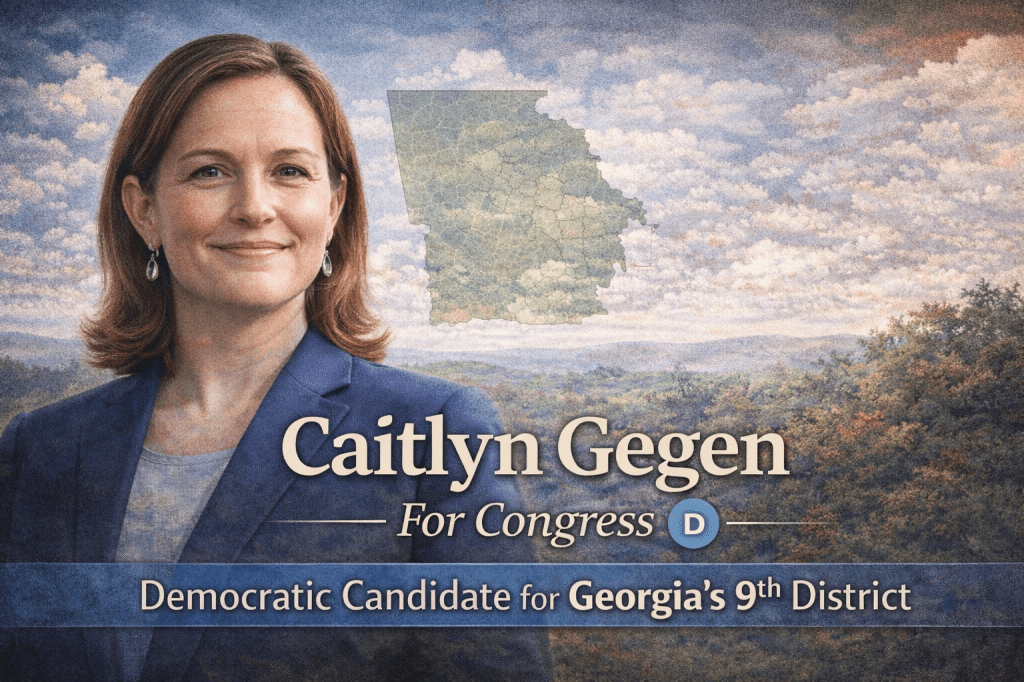
In my recent posts on Georgia’s 9th Congressional District, I worked to lay out the candidates and give a clear picture of the race. In doing that, I missed one: Caitlyn Gegen is also on the ballot.
Rather than dwell on the miss, I want to correct it and take the time to do what I’ve tried to do with the other candidates—look a little more closely at who she is and what she brings to the table.
Caitlyn Gegen represents a different kind of entry into this race than what we’ve seen so far. Where some candidates come in with long professional careers or prior time in public office, her profile reflects a more grassroots path—one that tends to be shaped by personal experience and community-level engagement.
That kind of background often brings a different perspective to politics. It can mean a stronger focus on day-to-day concerns, a closer connection to local communities, and a willingness to approach issues from the ground up rather than from inside established systems.
When you put that next to Nick Alex, the contrast is interesting.
Alex comes in with decades of experience in banking and a campaign that leans toward a centrist, district-aware message. His approach feels measured and structured—focused on fiscal responsibility, accessibility, and trying to meet the district where it is politically.
Gegen, by comparison, appears to be coming from a more personal and community-driven place. Candidates with that kind of background often emphasize lived experience and direct impact—how policies affect people in real situations, not just how they look on paper.
Neither approach is inherently better. They just speak to different ideas about what representation should look like.
One leans toward experience, structure, and navigating existing systems.
The other leans toward perspective, relatability, and building from the ground up.
In a district like Georgia’s 9th, where the general election landscape is what it is, campaigns like these can serve a broader purpose. They expand the conversation. They introduce different ways of thinking about familiar issues. And they give voters a chance to consider what kind of voice they want—even in a race where the outcome may seem predictable.
Adding Gegen into the picture doesn’t dramatically change the overall dynamics of the race. But it does make the field more complete—and that matters.
Because if we’re going to take elections seriously, we should take the full ballot seriously.
And that starts with making sure everyone on it gets a fair look.


Leave a Reply