
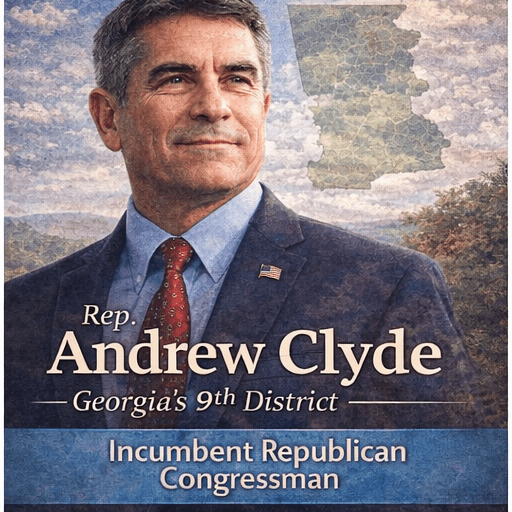
After taking a look at the challengers in Georgia’s 9th Congressional District, it only makes sense to spend some time on the person currently holding the seat: Andrew Clyde.
Incumbents always bring a different set of factors into a race. It’s not just about what they say they’ll do—it’s about what they’ve already done, how they’ve approached the job, and what kind of presence they’ve established both in Washington and back home.
Since taking office, Clyde has built a reputation as a consistent and reliable conservative vote. His record reflects a clear commitment to limited government, fiscal restraint, and a strict reading of constitutional principles. For many voters in the 9th District, that kind of consistency is exactly what they want to see.
He’s also positioned himself within one of the more influential conservative blocs in Congress, aligning with members who prioritize holding the line on spending and resisting policies they see as expanding the federal government too far. That approach has given him a defined role in the broader national conversation.
At the same time, holding office comes with opportunities that go beyond voting. Committee assignments, relationships, and time in Washington all create the potential to shape outcomes in ways that aren’t always visible in a simple yes-or-no vote.
Clyde’s seat on the Appropriations Committee is a good example of that. It’s one of the places where members can advocate directly for resources that impact their districts. Being in that room matters, and it’s an advantage not every representative has.
That leads to a natural question for voters: how should that influence be used?
For some, the priority is clear—stick to principle, vote consistently, and avoid compromise that could dilute those positions. From that perspective, Clyde’s approach makes sense and reflects exactly what he was sent to Washington to do.
For others, the focus is a little different. They’re interested in what comes back to the district—projects, investments, and tangible outcomes that affect everyday life. In that framework, effectiveness is measured not just by votes, but by results.
That’s where the conversation around Clyde tends to shift. Not necessarily in terms of disagreement, but in terms of emphasis. Has the balance between principle and practical outcomes been the right one? Could it look different?
There’s also the matter of how representation feels on the ground. In an era where national politics often dominates the conversation, some voters are looking for a stronger sense of connection—more visibility, more engagement, and more direct interaction with the district itself.
To be fair, that’s not a simple expectation to meet. The demands of serving in Congress are significant, and every member has to decide how to divide their time and attention between Washington and home.
Still, it remains part of the job, and it’s something voters are increasingly paying attention to.
All of this leaves voters in a position that’s actually pretty common in districts like this one. The choice isn’t about a dramatic shift in ideology. It’s about deciding what kind of representation matters most.
Consistency or flexibility. Principle or pragmatism. National voice or local focus.
There’s no single right answer to those questions. Different voters will land in different places, and that’s exactly how it should be.
What matters is taking the time to ask them.
Because in the end, incumbency brings both a record and an opportunity—an opportunity for voters to decide whether the current approach is the one they want to continue, or whether it’s time to try something a little different.


 The musings of Larry D Burton
Leave a comment