
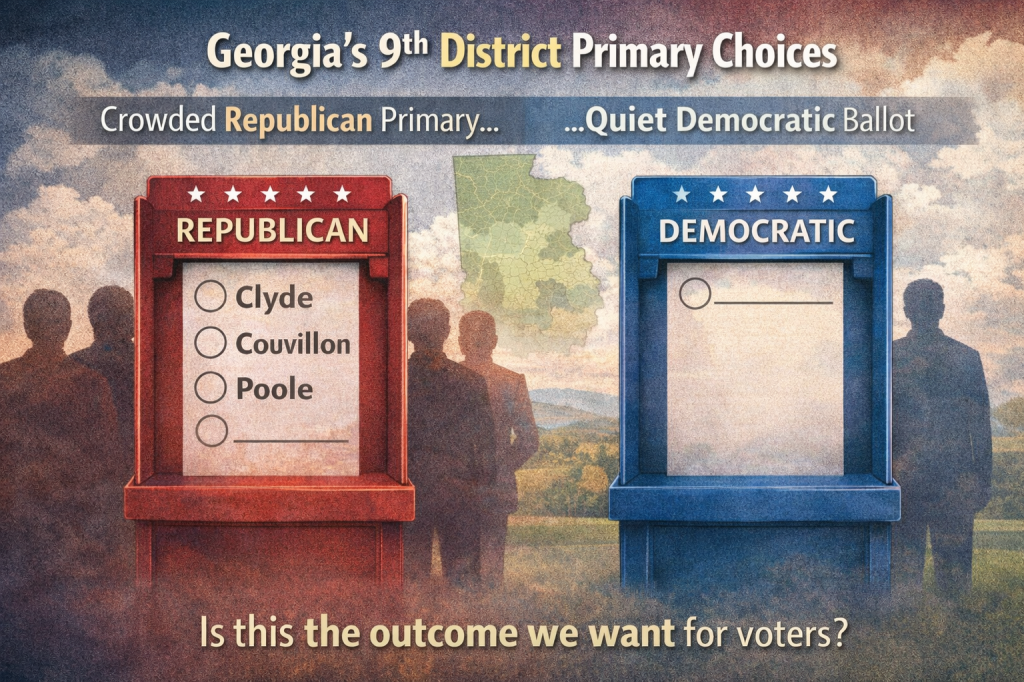
In a recent post, I took a look at the Republican primary for Georgia’s 9th Congressional District and the different candidates running there. In a district like ours, that primary is widely seen as the election that will decide who ends up in Congress.
Naturally, the next step seemed obvious—do the same thing for the Democratic candidates. Lay them out, compare their ideas, and give them the same level of attention. That’s how this is supposed to work, right?
But once I started digging into that, I ran into something unexpected. There just isn’t much there to evaluate. And that says something important—not just about this race, but about the system itself.
At the time I’m writing this, publicly available information on Democratic candidates in the 9th District is pretty limited. That’s not unusual in a district this heavily tilted toward one party, but it does create a real gap for voters who want to look at the full picture.
And that leads to a bigger issue. When one party dominates a district, the real competition shifts to the primary. The general election starts to feel more like a formality than a decision point. If you want your vote to matter, you’re almost pushed into choosing a side early.
For a lot of people, that’s not a comfortable place to be. Not everyone fits neatly into one party or the other. Some voters want to weigh all the options before making a decision, not pick a lane just to have a voice.
That doesn’t mean Democratic candidates—or potential candidates—don’t matter. They absolutely do. Even in a tough district, they can bring new ideas into the conversation, challenge assumptions, and highlight issues that might otherwise get overlooked.
In fact, some of the issues that come up most often around here—healthcare access, rural investment, infrastructure—benefit from having more than one perspective at the table. That kind of conversation makes for better outcomes, no matter who ends up winning.
At the same time, it’s fair to ask why it’s so hard to even identify viable candidates on one side of the ballot. Is it just political reality, or are there structural barriers that make it harder than it should be? Things like fundraising, ballot access rules, and the way primaries are set up all play a role.
This isn’t about criticizing any one candidate or party. It’s about recognizing a limitation in the system. When choices are narrow before voters even get to the general election, something important is missing.
So even if the Republican primary ends up deciding this race—as it likely will—it’s still worth paying attention to the full ballot. Looking at every candidate who steps forward, even in a long-shot campaign, helps round out the picture and keeps the process honest.
At the end of the day, elections work best when voters have real choices and real information. That’s something worth thinking about, no matter which side of the ballot you usually land on.
 The musings of Larry D Burton
Leave a comment