
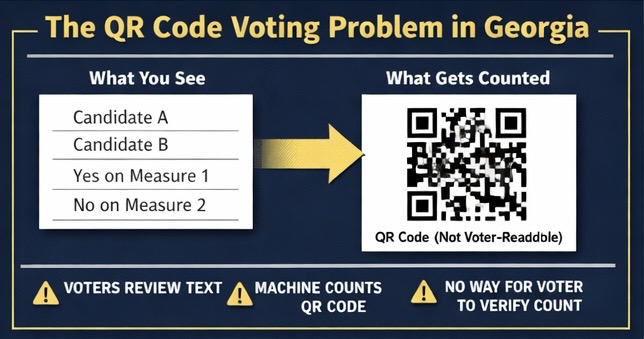
Georgia voters deserve confidence that their vote is accurately recorded, securely stored, and transparently counted. Right now, that confidence is under strain—not because of a single failure, but because of a structural flaw built into the state’s voting system: the use of QR codes on ballot-marking devices.
This is not a fringe concern. It is a practical, verifiable problem that cuts across party lines and goes to the heart of election integrity.
Georgia uses ballot-marking devices that print a paper ballot after a voter makes their selections. On its face, this sounds secure—a paper trail is created. But here’s the critical detail:
The machine prints both human-readable text and a QR code. When ballots are scanned and counted, the scanner reads the QR code—not the text.
That creates a disconnect.
A voter can review the text and believe their vote is correct, but the system ultimately counts the QR code, which the voter cannot read or verify. If there is ever a discrepancy—whether due to error, malfunction, or malicious interference—the voter has no meaningful way to catch it.
That is not a theoretical concern. It is a design flaw.
Why This Matters—Regardless of Politics
Election trust is not partisan. Republicans, Democrats, and independents all rely on the same system. If voters begin to doubt whether their selections are what actually get counted, the legitimacy of outcomes—win or lose—comes into question.
Even if the system works perfectly 99.9% of the time, the inability for voters to independently verify their ballot introduces doubt. And in elections, doubt spreads faster than facts.
Other states have moved toward hand-marked paper ballots or systems where the human-readable text is what gets counted. Georgia, by contrast, remains heavily reliant on a system where verification is effectively outsourced to the machine itself.
That’s not good enough.
The “QR Code Gap” in Election Integrity
At the heart of this issue is what can be called the “QR Code Gap”:
- Voters verify text.
- Machines count the code.
- There is no direct, voter-verifiable link between the two.
This gap undermines one of the most fundamental principles of a secure election system: that the voter can confirm their vote in a way that is actually used in the final count.
Without closing this gap, every audit, recount, or certification rests on a foundation the average voter cannot independently trust.
Why Waiting Is the Wrong Move
Some will argue that this issue can be addressed during the next regular legislative session. That is a mistake.
Elections are ongoing. Confidence, once lost, is difficult to restore. The longer this issue remains unresolved, the more it becomes a talking point, a suspicion, and eventually a belief—regardless of the facts on the ground.
Georgia has already been at the center of national election scrutiny. Leaving a known structural weakness unaddressed only invites further controversy and erodes public trust.
This is not a problem to study indefinitely. It is a problem to fix.
A Call to Governor Brian Kemp
Governor Kemp has positioned himself as a defender of election integrity and stability in Georgia. This moment calls for that leadership.
An extended or special legislative session should be convened with a narrow, focused mandate:
Ensure that votes counted are votes voters can verify.
Transition toward systems where human-readable ballots are the official record.
Establish clear, transparent audit procedures that the public can understand and trust.
This does not require reinventing the wheel. Proven models already exist in other states. What is required is urgency and political will.
What a Solution Could Look Like
A responsible reform package could include:
- Expanding the use of hand-marked paper ballots, especially for in-person voting.
- Requiring that optical scanners count human-readable text, not QR codes.
- Strengthening risk-limiting audits to verify outcomes independently of machine encoding.
- Providing clear voter education on how ballots are cast and counted.
- These are practical, achievable steps—not partisan demands.
The Stakes Are Higher Than One Election
This issue is bigger than any candidate or party. It goes to the credibility of the entire system.
If voters cannot verify what is being counted, then trust must be borrowed—from machines, from officials, from assurances. That is not how a healthy democracy operates.
Trust should be earned through transparency, not assumed through complexity.
Conclusion: Fix It Now
Georgia has an opportunity to lead—not by defending the current system, but by improving it.
The QR code issue is a solvable problem. Ignoring it, delaying it, or minimizing it only increases the risk that future elections will be clouded by doubt.
Governor Kemp and the Georgia legislature should act now—before the next election cycle—not after controversy forces their hand.
Call the session. Close the gap. Restore confidence.
 The musings of Larry D Burton
Leave a comment