
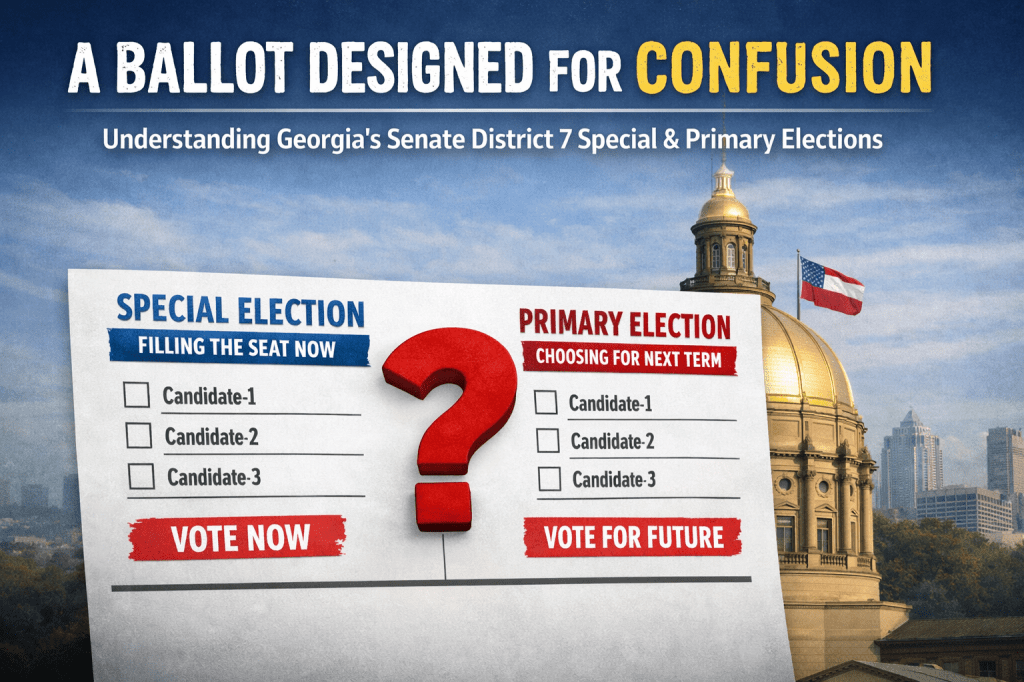
In Georgia State Senate District 7, voters are being asked to do something unusual: vote for the same office twice on the same day. One vote fills the seat immediately through a special election, while the other determines party nominees for the next full term through a primary. While technically sound from a legal standpoint, this structure creates a high likelihood of voter confusion—and that confusion has real consequences.
Most voters approach the ballot with a simple expectation: they are choosing their next representative. But in this case, that assumption breaks down. Instead, voters are faced with two parallel decisions that operate on different timelines. The special election determines who will serve right away, filling the vacancy left mid-term. The primary election, by contrast, sets up a future contest that will ultimately decide who holds the seat for the next full term.
The problem is not complexity alone—it’s layered complexity without clear guidance. The ballot does not naturally walk voters through these distinctions. Instead, it presents two similar-looking races with the same district label, often separated only by section headings that are easy to overlook. One appears in a general or nonpartisan format, while the other is embedded within a party-specific primary ballot. For an engaged voter, this is manageable. For the average voter, it’s a trap.
This confusion leads to predictable mistakes. Some voters will participate in one race and skip the other, believing they are redundant. Others may vote inconsistently, choosing different candidates without realizing they are making separate decisions about the present and the future. Still others may disengage entirely when the ballot feels unclear or overwhelming.
The broader issue here is trust. Elections should be accessible, understandable, and transparent. When the structure of a ballot requires voters to stop and decipher process rather than focus on choice, the system begins to favor those who are already highly informed. That tilts the playing field away from ordinary citizens and toward habitual voters and political insiders.
A better approach would separate these elections or provide clearer, unavoidable guidance at the point of voting. Short of that, the responsibility falls on voters—and those informing them—to understand what is being asked.
The simplest way to think about it is this: voters are making two decisions about the same seat—one for who serves now, and one for who may serve next. Recognizing that distinction is the key to voting intentionally rather than accidentally.
In a system that depends on informed participation, clarity is not a luxury. It is a requirement.


 The musings of Larry D Burton
Leave a comment