
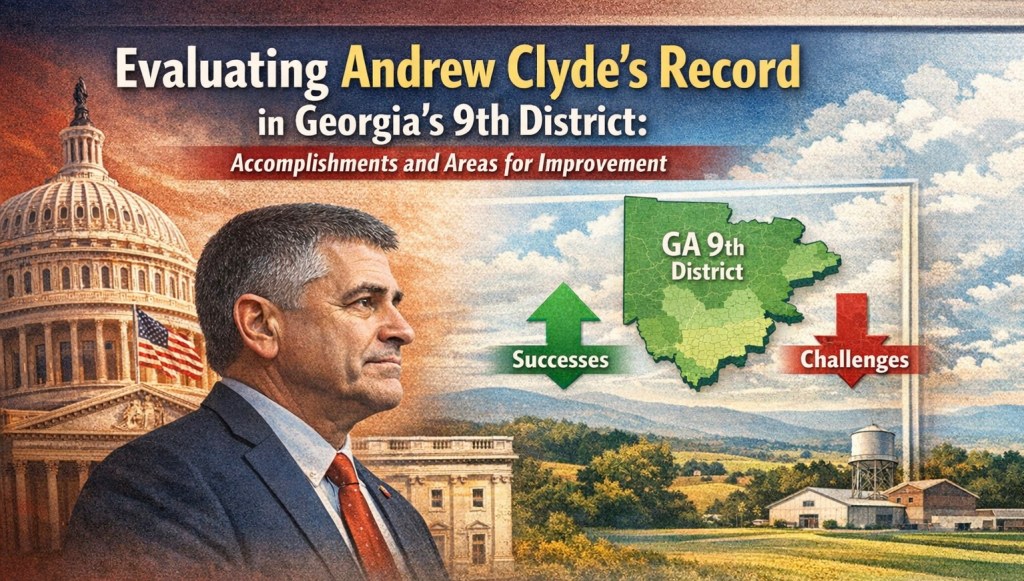
As voters in Georgia’s 9th Congressional District look toward the upcoming election, it is worth taking a thoughtful and measured look at the record of our current representative, Andrew Clyde. In a district as reliably conservative as ours, the question is often not about party control, but about how effectively that representation serves the people who live here.
Congressman Clyde has built a reputation as a principled and consistent conservative voice in Washington. His voting record reflects a clear commitment to limited government, fiscal restraint, and constitutional principles. For many in District 9, that consistency is not only expected—it is appreciated.
At the same time, representation is about more than ideology alone. It also involves delivering tangible results, maintaining strong connections to the district, and ensuring that local priorities are advanced alongside national ones.
To his credit, Congressman Clyde has secured influential committee assignments, including a seat on the House Appropriations Committee. This position provides an opportunity—one that not all members of Congress have—to advocate directly for federal resources and investments that can benefit communities across North Georgia. His presence in these discussions ensures that the district has a voice at the table when funding decisions are made.
Clyde has also been a reliable advocate for issues that resonate strongly with many voters in the district, including Second Amendment rights, border security, and opposition to excessive federal spending. His willingness to take firm positions, even when they are not politically convenient, has earned him respect among constituents who value conviction and clarity.
However, there are also areas where voters may reasonably seek more. While Congressman Clyde’s principled approach is clear, the visible outcomes of that approach at the district level are less so. In an era when federal funding often depends on negotiation and coalition-building, a consistently oppositional stance can limit opportunities to secure specific projects or targeted investments for local communities.
This raises an important and fair question for voters: how should success in Congress be measured? Is it defined primarily by adherence to principle, or by the ability to translate those principles into tangible improvements for the district? Different voters will answer that question in different ways, but it is a conversation worth having openly and honestly.
There is also the matter of tone and focus. In today’s political climate, national debates and ideological conflicts often dominate the conversation. While those issues are undeniably important, many voters in District 9 are also interested in ensuring that their representative remains grounded in the everyday concerns of the region—economic development, infrastructure, and local opportunity.
It is within this context that the candidacies of Sam Couvillon and Gregg Poole deserve thoughtful consideration. Both candidates bring experience in local government and offer perspectives shaped by direct engagement with their communities.
Couvillon, drawing on his experience as a mayor, emphasizes a results-oriented approach to governance. His background suggests a focus on execution, economic development, and the practical challenges of managing growth and infrastructure at the local level. For voters who place a premium on measurable outcomes, this approach may be appealing.
Poole, as a county commissioner, highlights accessibility and connection to constituents. His experience at the county level reflects a close understanding of local needs and priorities, and his campaign underscores the importance of maintaining a strong presence within the district itself.
Neither of these candidacies represents a departure from the conservative values that define Georgia’s 9th District. Rather, they offer alternative approaches to how those values might be translated into representation—whether through managerial execution, local engagement, or a different balance between principle and pragmatism.
Ultimately, the decision facing voters is not a simple one, nor should it be. Congressman Clyde has demonstrated consistency and conviction in his time in office, and those qualities carry real weight. At the same time, elections provide an opportunity to reflect, reassess, and consider whether a different approach might better serve the evolving needs of the district.
A healthy political process depends on informed voters who are willing to look beyond party labels and engage with the substance of each candidate’s record and vision. As this election approaches, taking the time to evaluate all three candidates—what they have done, what they propose to do, and how they intend to serve—will ensure that Georgia’s 9th District continues to be represented in a way that reflects both its values and its aspirations.
 The musings of Larry D Burton
Leave a comment